…hopes have been dashed too many times before. Yet, as the Guardian reports:
Another one in the eye for Australia
Australians 342-5; Somerset 345-6: Somerset won by four wickets
David Hopps in Taunton
Thursday June 16, 2005
Australia claimed that their Twenty20 thrashing against England was "just a bit of fun", so presumably defeat yesterday against Somerset ranked as bloody hilarious.
Not for Ricky Ponting it didn't. Australia's captain looked incandescent about a tour which has begun in disarray.
"It was pretty embarrassing," he spat. "The way we have played the last couple of days we will have our work cut out to beat Bangladesh."
Australia, beaten by four wickets with 19 balls to spare, headed to Cardiff last night for their opening NatWest Series match against Bangladesh on Saturday with Brett Lee facing a scan on an injured shoulder, with their bowling looking strangely vulnerable and with them fielding like old men.
I know that pride comes before a fall, you should never count your chickens and that he who laughs last etc, but all the same…
...Tee hee.

Thursday, June 16, 2005


Wednesday, June 15, 2005
If the CAP fits...
From the Times:
MARTIAL headlines filled the air in France yesterday as the Prime Minister landed to do battle with the leader of Britain’s ancient adversary.
“Le Choc Blair-Chirac”, announced the television news. Radio and newspapers hauled out a famous quotation: “Messieurs les anglais, tirez le premiers!” The invitation to shoot first was made by the French commander to the Duke of Cumberland’s men at the battle of Fontenoy in 1745.
The army of King Louis XV defeated les rosbifs then, but beyond headlines there was little Gallic self-confidence on display yesterday when the two old European powers engaged in their umpteenth replay of the 100 years war.
As M Chirac leaned on Mr Blair to abandon le cheque britannique at the European Union summit in Brussels tomorrow, French thoughts were turning towards a southern suburb of the Belgian capital — Waterloo. The reminder of the Anglo-French showdown of June 18, 1815 was partly the fault of Dominique de Villepin, M Chirac’s new Prime Minister. He drew mockery last week with a promise to revive France’s ailing economy in 100 days. Les Cent Jours is French shorthand for Napoleon Bonaparte’s adventures between Elba and Brussels, where he was halted by the British and Prussians.
This time the Germans are on the French side, with Chancellor Schröder, albeit politically enfeebled, calling for British sacrifice.
Britain may look isolated in the EU, but in the view of French politicians and commentators, Mr Blair has by far the stronger hand. Freshly re-elected, Mr Blair impresses a Gallic establishment that has been sorely rattled by the voters’ mutiny against the Constitution and which has little faith in M Chirac’s ability to pull off a Fontenoy.
“We are watching a virile arm-wrestling match between Jacques Chirac and Tony Blair, but does the President have the means to stand up to perfidious Albion?” asked a commentator on France Inter’s breakfast programme yesterday. “What is the weight of a French President humiliated by the voters facing a freshly re-elected Tony Blair?” he wondered.
LCI television news said that M Chirac could not expect Britain to give up its rebate while refusing to reform farms spending. “It will be difficult for France to avoid paying the political and economic price at the European summit of its ‘No’ to the European constitution on May 29,” it said.
Valéry Giscard d’Estaing, chief author of the doomed Constitution, gave his verdict on the referendum for the first time yesterday, blaming M Chirac for bungling the campaign. “France has reinforced its negative image in Europe as an arrogant, untrustworthy country,” said the former President.
M Chirac’s offensive is seen as a ploy to divert attention from the referendum debacle. “The real battlefield between Paris and London is not the Constitution,” said l’Humanité, the Communist Party daily. “Contrary to the historic quote, it is the French who have shot first by demanding an end to the British rebate. The British have shot back fast (on the Common Agriculture Policy)...
For Jacques Chirac, this showdown with perfidious Albion is the ideal opportunity to duck the issue.” The President wanted to win public support by whipping up a quarrel with France’s historic enemy, defending the “French Social Model” against British free-market doctrines, said l’Humanité.
M Chirac is depicting himself as the champion of the compassionate French social model in a struggle with the supposedly cruel “modèle anglo-saxon” embodied by the Constitution — at least in the view of “no” voters. The CAP, invented by France, is part of the French model.
The trouble for M Chirac is that the “non” has served as shock therapy, forcing France to examine the weakness of its cherished welfare system of tight regulation and high taxes. Patrick Devedjian, a former Minister who is close to Nicolas Sarkozy, M Chirac’s chief political rival, said:
“The French social model is not a model because no-one wants to emulate it. It is not social because it causes record unemployment.”
In similar vein, l’Express magazine said that France was fooling itself if it thought anyone wanted the French model. “This is the cruel truth: Because we were not paying attention, there is no French Social model any more.”
In sarcastic mood, Pascal Bruckner, a leading novelist, suggested in le Figaro yesterday that France should turn itself into a giant theme park where tourists would come to learn how to strike and to hate “the horror that is the free market”.
This won’t exactly hurt Blair’s domestic popularity.
Agricultural subsidies - ie. the artificial propping up of industries producing goods that nobody wants - account for about 40% of the total EU budget, or 47.4 billion euros
France, one of 25 member states, gets a quarter of that. Farmers represent just 4% of the total French workforce.
M. Chirac says: “The time has come for our British friends to understand that they must now make a gesture of solidarity.”
M. Chirac has un nerve.
MARTIAL headlines filled the air in France yesterday as the Prime Minister landed to do battle with the leader of Britain’s ancient adversary.
“Le Choc Blair-Chirac”, announced the television news. Radio and newspapers hauled out a famous quotation: “Messieurs les anglais, tirez le premiers!” The invitation to shoot first was made by the French commander to the Duke of Cumberland’s men at the battle of Fontenoy in 1745.
The army of King Louis XV defeated les rosbifs then, but beyond headlines there was little Gallic self-confidence on display yesterday when the two old European powers engaged in their umpteenth replay of the 100 years war.
As M Chirac leaned on Mr Blair to abandon le cheque britannique at the European Union summit in Brussels tomorrow, French thoughts were turning towards a southern suburb of the Belgian capital — Waterloo. The reminder of the Anglo-French showdown of June 18, 1815 was partly the fault of Dominique de Villepin, M Chirac’s new Prime Minister. He drew mockery last week with a promise to revive France’s ailing economy in 100 days. Les Cent Jours is French shorthand for Napoleon Bonaparte’s adventures between Elba and Brussels, where he was halted by the British and Prussians.
This time the Germans are on the French side, with Chancellor Schröder, albeit politically enfeebled, calling for British sacrifice.
Britain may look isolated in the EU, but in the view of French politicians and commentators, Mr Blair has by far the stronger hand. Freshly re-elected, Mr Blair impresses a Gallic establishment that has been sorely rattled by the voters’ mutiny against the Constitution and which has little faith in M Chirac’s ability to pull off a Fontenoy.
“We are watching a virile arm-wrestling match between Jacques Chirac and Tony Blair, but does the President have the means to stand up to perfidious Albion?” asked a commentator on France Inter’s breakfast programme yesterday. “What is the weight of a French President humiliated by the voters facing a freshly re-elected Tony Blair?” he wondered.
LCI television news said that M Chirac could not expect Britain to give up its rebate while refusing to reform farms spending. “It will be difficult for France to avoid paying the political and economic price at the European summit of its ‘No’ to the European constitution on May 29,” it said.
Valéry Giscard d’Estaing, chief author of the doomed Constitution, gave his verdict on the referendum for the first time yesterday, blaming M Chirac for bungling the campaign. “France has reinforced its negative image in Europe as an arrogant, untrustworthy country,” said the former President.
M Chirac’s offensive is seen as a ploy to divert attention from the referendum debacle. “The real battlefield between Paris and London is not the Constitution,” said l’Humanité, the Communist Party daily. “Contrary to the historic quote, it is the French who have shot first by demanding an end to the British rebate. The British have shot back fast (on the Common Agriculture Policy)...
For Jacques Chirac, this showdown with perfidious Albion is the ideal opportunity to duck the issue.” The President wanted to win public support by whipping up a quarrel with France’s historic enemy, defending the “French Social Model” against British free-market doctrines, said l’Humanité.
M Chirac is depicting himself as the champion of the compassionate French social model in a struggle with the supposedly cruel “modèle anglo-saxon” embodied by the Constitution — at least in the view of “no” voters. The CAP, invented by France, is part of the French model.
The trouble for M Chirac is that the “non” has served as shock therapy, forcing France to examine the weakness of its cherished welfare system of tight regulation and high taxes. Patrick Devedjian, a former Minister who is close to Nicolas Sarkozy, M Chirac’s chief political rival, said:
“The French social model is not a model because no-one wants to emulate it. It is not social because it causes record unemployment.”
In similar vein, l’Express magazine said that France was fooling itself if it thought anyone wanted the French model. “This is the cruel truth: Because we were not paying attention, there is no French Social model any more.”
In sarcastic mood, Pascal Bruckner, a leading novelist, suggested in le Figaro yesterday that France should turn itself into a giant theme park where tourists would come to learn how to strike and to hate “the horror that is the free market”.
This won’t exactly hurt Blair’s domestic popularity.
Agricultural subsidies - ie. the artificial propping up of industries producing goods that nobody wants - account for about 40% of the total EU budget, or 47.4 billion euros
France, one of 25 member states, gets a quarter of that. Farmers represent just 4% of the total French workforce.
M. Chirac says: “The time has come for our British friends to understand that they must now make a gesture of solidarity.”
M. Chirac has un nerve.
Tuesday, June 14, 2005
Stick THAT on yer barbie
Following England 100-run mauling of Australia last night, the Times reports:
SNOBBERY begone. Let us make Test matches a thing of the past, let us consign the one-day international to the landfill site of history and let us embrace Twenty20 as the best — no, the only form of the game. Never mind beauty and let subtlety go hang, for last night England wiped the floor with Australia in a cricket match.
…
TO A mixture of delight and disbelief among a capacity crowd of 15,000, Australia began the Ashes summer by suffering the kind of defeat that even they have rarely inflicted upon opponents. The only concern for England on a balmy evening when almost everything went right is that expectation among the public will be even higher for the weeks ahead.
Led by Jon Lewis, on his first appearance at this level, and Darren Gough, England claimed seven wickets for eight runs during a storybook passage of 20 balls to ensure that the first Twenty20 international in this country will remain long in the memory. At one point a chorus of “Are you Bangladesh in disguise?” rang around the stands, as Australia subsided to the second-lowest Twenty20 total in this country after Sussex’s 67 against Hampshire at Hove almost a year ago.
Ok, it was only Twenty20, but it was terrific entertainment and wonderful to watch the Aussies squirm in humiliation.
It might mean nothing for the one-dayers and the Ashes, or it might mean everything. There were at least two key things from the game:
1. For the first time in recent memory, the Aussies now know that we’re not frightened of them. They’ve also found out that this team can dig itself out of tight spots through grit and determination, instead of suffering the traditional middle-order collapse.
2. For once, it was us dishing out the intimidation. In the context of the game, Flintoff’s ferocious short bowling into the ribs and throat of Bret Lee was pointless. But as a taster of what to expect come August, it was genius.
Having got my hands on some prized tickets for the first game proper in Bristol on Sunday, I’m getting really quite excited…
Wednesday, June 08, 2005
Boom Town Prat?
Writes Magnus Linklater:
THERE ARE TWO Bob Geldofs. One is an articulate and persuasive speaker, who commands the attention and respect of world leaders as well as experts in the field of global poverty. The other one is completely mad.
What on earth is he doing, inviting a million people to march on Edinburgh? Did he consult the city fathers first, find out whether the police could cope, or work out whether there were enough Portaloos to go round? What gives him the right to tell children to “bunk off” school for two days, because he believes that protest is more important than geometry? Did he talk to the teachers and ask them what this would do to their classes?
By what lunatic leap of the imagination did he decide to restage Dunkirk and embark a fleet of protesters from France? Did he study the tanker routes or consult the coastguards?
Of course not — he told them afterwards. This is Geldof the licensed fool, and just as the fool is allowed to thumb his nose at the king, so Geldof the demagogue, deploying his charm, his four-letter directness and his Live Aid credentials, can break the rules with impunity, organising mayhem in other peoples’ cities while sheltering behind the all-embracing defence of “making poverty history”. This is not only foolish, it is a disservice to Africa, and Geldof, of all people, should realise that.
Anyone who has heard him speak — as I did in the Scottish Parliament recently — appreciates that he has grasped the arguments about Africa, understands how aid works and how aid, wrongly applied, can make things worse. He knows the argument is not just about money. Over the past 40 years, Africa has received more foreign aid in real terms than the Marshall Plan. Most of this has been swallowed up by corrupt governments and civil wars, leaving millions worse off than before. Geldof is, therefore, in a unique position to explain how the West should tackle poverty, without repeating the mistakes of the past.
Instead, he has buried the explanations beneath a naked appeal to popular outrage. By linking the protest march with his Live 8 concerts, he is presenting two quite separate issues as one. The first is about raising money, the second is about engineering change.
Most of those who descend on Edinburgh will assume from Geldof’s rhetoric that the capitalist West has, through a combination of greed and selfishness, failed the people of Africa; that if only its leaders could be persuaded to give more generously, increasing their share of national budgets and cancelling African debts, then we would no longer, as he puts it, have to “tolerate the 21st century Orwellian vision of people dying on our television screens every night”.
The truth, as he must be aware, is not only more complex, it is deeply troubling for anyone who bothers to think beyond the safe confines of the liberal conscience. It is that President Bush’s hard-edged African policies come closer to finding a solution than those of Tony Blair or Gordon Brown. Britain argues that Western aid to Africa should be doubled, and some $15 billion worth of loans should be written off. Although channelled through Mr Brown’s proposed International Finance Facility, the funding would still be negotiated directly with African governments, many of which remain as corrupt and secretive as those of the old dictatorships that brought the continent to its knees in the 1970s and 1980s. America, by contrast, is insisting that funds should be channelled only to countries that tackle corruption, improve accountability and reform their banking systems.
Mr Blair’s Africa Commission shies away from this. It concedes that corruption is a problem, but assumes that today’s regimes are more open and honest. “Africa, at last, looks set to deliver,” it pronounces. Yet barely three years have passed since four million people fell victim to civil war in the Congo; an estimated 200,000 have died in Darfur; the economy of once wealthy Zimbabwe has collapsed; corruption is endemic in countries such as Kenya, Ethiopia, the Ivory Coast, Gabon and Cameroon. To determine from this that Africa has reformed itself is naive to the point of blindness.
If Geldof were to use his huge influence to maximum effect he might say something like this: change in Africa can only begin in Africa itself. Simply pouring more money into the purses of corrupt regimes will do nothing except to inflate their laundered bank accounts in London and Zurich and leave their people starving. Support should be channelled directly to those local areas and those local communities that need help to stand on their own feet, where small farmers and small businesses can thrive if given the incentive to do it, and where there is complete transparency about who owns what and how the money is spent. Only those agencies that have shown themselves to be truly independent of governments will be allowed to administer funds. Only regimes that are prepared to be open and accountable to their own people will receive help. Meanwhile, there is a message for Western nations which the G8 leaders should debate and agree: they must stop dumping their surpluses on Africa and grotesquely subsidising their own industries — the US cotton industry is a case in point.
Instead of requisitioning an army of protesters to descend on Edinburgh, bringing that harmless city to a standstill, Geldof should ask his foot soldiers to stay at home and send the money that they would have spent on travelling to a special account reserved for making small but effective changes to Africa’s faltering democracies. All proceeds from the Live 8 concerts should bypass national governments and go direct to local communities, serviced by reliable agencies. Meanwhile, Geldof the madman should give way to Geldof the far-sighted. Like Malvolio he is “wise enough to play the fool”. He should be clever enough to grow up as well.
There are two tempting but opposite reactions to Geldof, both wrong. The first is to dismiss him as a tiresome, misguided fool on a big ego-trip. The second is to believe that he has all the answers and that it really is easy to solve Africa’s problems by working ourselves up into a good self-righteous lather, listening to Coldplay and haranguing those evil western politicians at the G8 summit.
The answer is somewhere in the middle. You can pour all the money in the world into Africa and it will do nothing other than temporarily salve the conscience of western liberals and inflate the private bank balances of some really unpleasant African regimes.
In this instance, the Americans have it about right. Get tough on the corruption, give people the freedom to start making their own money, and aid can start to mean something.
THERE ARE TWO Bob Geldofs. One is an articulate and persuasive speaker, who commands the attention and respect of world leaders as well as experts in the field of global poverty. The other one is completely mad.
What on earth is he doing, inviting a million people to march on Edinburgh? Did he consult the city fathers first, find out whether the police could cope, or work out whether there were enough Portaloos to go round? What gives him the right to tell children to “bunk off” school for two days, because he believes that protest is more important than geometry? Did he talk to the teachers and ask them what this would do to their classes?
By what lunatic leap of the imagination did he decide to restage Dunkirk and embark a fleet of protesters from France? Did he study the tanker routes or consult the coastguards?
Of course not — he told them afterwards. This is Geldof the licensed fool, and just as the fool is allowed to thumb his nose at the king, so Geldof the demagogue, deploying his charm, his four-letter directness and his Live Aid credentials, can break the rules with impunity, organising mayhem in other peoples’ cities while sheltering behind the all-embracing defence of “making poverty history”. This is not only foolish, it is a disservice to Africa, and Geldof, of all people, should realise that.
Anyone who has heard him speak — as I did in the Scottish Parliament recently — appreciates that he has grasped the arguments about Africa, understands how aid works and how aid, wrongly applied, can make things worse. He knows the argument is not just about money. Over the past 40 years, Africa has received more foreign aid in real terms than the Marshall Plan. Most of this has been swallowed up by corrupt governments and civil wars, leaving millions worse off than before. Geldof is, therefore, in a unique position to explain how the West should tackle poverty, without repeating the mistakes of the past.
Instead, he has buried the explanations beneath a naked appeal to popular outrage. By linking the protest march with his Live 8 concerts, he is presenting two quite separate issues as one. The first is about raising money, the second is about engineering change.
Most of those who descend on Edinburgh will assume from Geldof’s rhetoric that the capitalist West has, through a combination of greed and selfishness, failed the people of Africa; that if only its leaders could be persuaded to give more generously, increasing their share of national budgets and cancelling African debts, then we would no longer, as he puts it, have to “tolerate the 21st century Orwellian vision of people dying on our television screens every night”.
The truth, as he must be aware, is not only more complex, it is deeply troubling for anyone who bothers to think beyond the safe confines of the liberal conscience. It is that President Bush’s hard-edged African policies come closer to finding a solution than those of Tony Blair or Gordon Brown. Britain argues that Western aid to Africa should be doubled, and some $15 billion worth of loans should be written off. Although channelled through Mr Brown’s proposed International Finance Facility, the funding would still be negotiated directly with African governments, many of which remain as corrupt and secretive as those of the old dictatorships that brought the continent to its knees in the 1970s and 1980s. America, by contrast, is insisting that funds should be channelled only to countries that tackle corruption, improve accountability and reform their banking systems.
Mr Blair’s Africa Commission shies away from this. It concedes that corruption is a problem, but assumes that today’s regimes are more open and honest. “Africa, at last, looks set to deliver,” it pronounces. Yet barely three years have passed since four million people fell victim to civil war in the Congo; an estimated 200,000 have died in Darfur; the economy of once wealthy Zimbabwe has collapsed; corruption is endemic in countries such as Kenya, Ethiopia, the Ivory Coast, Gabon and Cameroon. To determine from this that Africa has reformed itself is naive to the point of blindness.
If Geldof were to use his huge influence to maximum effect he might say something like this: change in Africa can only begin in Africa itself. Simply pouring more money into the purses of corrupt regimes will do nothing except to inflate their laundered bank accounts in London and Zurich and leave their people starving. Support should be channelled directly to those local areas and those local communities that need help to stand on their own feet, where small farmers and small businesses can thrive if given the incentive to do it, and where there is complete transparency about who owns what and how the money is spent. Only those agencies that have shown themselves to be truly independent of governments will be allowed to administer funds. Only regimes that are prepared to be open and accountable to their own people will receive help. Meanwhile, there is a message for Western nations which the G8 leaders should debate and agree: they must stop dumping their surpluses on Africa and grotesquely subsidising their own industries — the US cotton industry is a case in point.
Instead of requisitioning an army of protesters to descend on Edinburgh, bringing that harmless city to a standstill, Geldof should ask his foot soldiers to stay at home and send the money that they would have spent on travelling to a special account reserved for making small but effective changes to Africa’s faltering democracies. All proceeds from the Live 8 concerts should bypass national governments and go direct to local communities, serviced by reliable agencies. Meanwhile, Geldof the madman should give way to Geldof the far-sighted. Like Malvolio he is “wise enough to play the fool”. He should be clever enough to grow up as well.
There are two tempting but opposite reactions to Geldof, both wrong. The first is to dismiss him as a tiresome, misguided fool on a big ego-trip. The second is to believe that he has all the answers and that it really is easy to solve Africa’s problems by working ourselves up into a good self-righteous lather, listening to Coldplay and haranguing those evil western politicians at the G8 summit.
The answer is somewhere in the middle. You can pour all the money in the world into Africa and it will do nothing other than temporarily salve the conscience of western liberals and inflate the private bank balances of some really unpleasant African regimes.
In this instance, the Americans have it about right. Get tough on the corruption, give people the freedom to start making their own money, and aid can start to mean something.
Tuesday, June 07, 2005
Et tu, Ashley?
Football and loyalty
Simon Barnes of The Times (who I suppose is less a sports reporter than a ‘meta-sports reporter’. He doesn’t write match reports but focuses on the nature, drama and raison d’etre of sport) pens the following thoughts on football loyalty, in the wake of the Ashley Cole/Chelsea ‘tapping up’ affair:
It was not the disloyalty of Ashley Cole that shocked. It was the blatant disloyalty. It is one thing to break the rules, apparently, but it is another thing entirely to be blatant about it.
I accept that you may be unfaithful, darling, but if I come home and find the bed still warm and unmade and a woman in the bath, I will be seriously upset.
…
Nobody expects loyalty, but everybody has a preference for the illusion of loyalty. That is because loyalty is the founding principle of professional football. Without loyalty, football could not exist. Without loyalty, football would have no point. Football is a paradox — a game about loyalty in which no loyalty at all is expected from its principals.
Supporters take loyalty with astonishing seriousness. In even mildly exacting football circles, a man will arouse less censure if he changes his newspaper, his political allegiance or his wife than if he changes his club. You’re United till you die. Or City. Or whatever.
Francis Hodgson writes about footballing loyalty in his excellent Only The Goalkeeper To Beat — and about his bewilderment. For him, watching one club and refusing to watch another is like going to the English National Opera and refusing to go to Covent Garden or Glyndebourne. But in footballing circles, Hodgson’s view threatens the very basis of society.
The late Matthew Harding, the former Chelsea director, declared: “I’m not interested in football. I’m interested in Chelsea.” It’s a tenable point of view: I’m not interested in sexual relationships, I’m interested in my wife. And whether or not we agree with the principle, we must accept that it is how football works. Football exists as a vector for loyalty.
….
The point is that loyalty, to the point of absurdity, to the point of warped judgment, is the way in which football works. Most of the chants at grounds are hymns to loyalty, to group identity, to the fact that we are all members of whoever-it-is-this-time’s black-and-white army.
Supporters demand a lifelong commitment from themselves and from each other and they dream of such a commitment from players and managers. But here’s the gut-wrenching truth: they get it less and less.
In football, only those who pay are loyal. Those who get paid have long relinquished loyalty. Every player in the world will leave any club and move to another if the money is better and the opportunity more thrilling.
Wayne Rooney — Everton till I die — joined Manchester United. Alan Smith, serial badge-slobberer for Leeds United, joined Manchester United. That is doubly disloyal, by the way, because if you are Leeds you have to “hate” Manchester United. So Smith was called “Judas”. The fans thought he was a fan, by definition loyal. But he was a player, by definition disloyal.
….
No one in football is loyal. Executives move clubs (Kenyon from Manchester United to Chelsea), chairmen move clubs (Ken Bates from Chelsea to Leeds), managers, players and backroom staff move clubs all the time. Only the fans stay loyal: loyal to the club, loyal to each other, loyal, above all, to the concept of loyalty.
The endemic disloyalty in football means that no sane person can regard the game without a deep and weary cynicism. No act of disloyalty from footballers would cause the faintest ripple of shock anywhere in the world. But, all the time, the game they play would not exist without loyalty.
Loyalty is football’s bread and butter, its jam and caviar. Loyalty funds football. Football has its being in a culture of disloyalty, and it was all made possible by the loyalty of football supporters.
Loyalty to a football club is worse than blind loyalty, in that you’re not blind. You can see when your club is ripping you off, behaving badly, playing like a bunch of donkeys, making terrible managerial decisions. You moan like hell about it. But you carry on being loyal anyway.
It’s more like straitjacket loyalty. And nobody is forcing you to wear the jacket. You bought it yourself, and you probably paid the extra tenner to have the name of last season’s top scorer printed on the back.
In the past I’ve been involved in various Liverpool FC fanzines and websites. During the dark days of Houllier’s final seasons, the best fanzine, Through the Wind and Rain (just the name, taken from the red anthem You'll Never Walk Alone, is another expression of come-what-may loyalty), was just one long spew of bile: against the manager, the lazy players, the chairman, the chief executive, and the rotten style of football. One long piece of hate mail. Yet there these writers were, plodding along to every home and away game, moaning, whining, and spending a fortune on the club.
Of course, Liverpool supporters have got the excuse that we can go through all the mediocrity and rubbish for a few decades and then suddenly you get a night like Istanbul. But what of the followers of Everton, QPR, Scunthorpe? What of Newcastle, an entire city of hundreds of thousands of fanatics in barcode tops, generation after generation, who have never seen their club win anything, ever?
Stupid, straitjacket loyalty.
All clubs depend on it. The worst (Manchester United and Chelsea) exploit it. And win things.
Simon Barnes of The Times (who I suppose is less a sports reporter than a ‘meta-sports reporter’. He doesn’t write match reports but focuses on the nature, drama and raison d’etre of sport) pens the following thoughts on football loyalty, in the wake of the Ashley Cole/Chelsea ‘tapping up’ affair:
It was not the disloyalty of Ashley Cole that shocked. It was the blatant disloyalty. It is one thing to break the rules, apparently, but it is another thing entirely to be blatant about it.
I accept that you may be unfaithful, darling, but if I come home and find the bed still warm and unmade and a woman in the bath, I will be seriously upset.
…
Nobody expects loyalty, but everybody has a preference for the illusion of loyalty. That is because loyalty is the founding principle of professional football. Without loyalty, football could not exist. Without loyalty, football would have no point. Football is a paradox — a game about loyalty in which no loyalty at all is expected from its principals.
Supporters take loyalty with astonishing seriousness. In even mildly exacting football circles, a man will arouse less censure if he changes his newspaper, his political allegiance or his wife than if he changes his club. You’re United till you die. Or City. Or whatever.
Francis Hodgson writes about footballing loyalty in his excellent Only The Goalkeeper To Beat — and about his bewilderment. For him, watching one club and refusing to watch another is like going to the English National Opera and refusing to go to Covent Garden or Glyndebourne. But in footballing circles, Hodgson’s view threatens the very basis of society.
The late Matthew Harding, the former Chelsea director, declared: “I’m not interested in football. I’m interested in Chelsea.” It’s a tenable point of view: I’m not interested in sexual relationships, I’m interested in my wife. And whether or not we agree with the principle, we must accept that it is how football works. Football exists as a vector for loyalty.
….
The point is that loyalty, to the point of absurdity, to the point of warped judgment, is the way in which football works. Most of the chants at grounds are hymns to loyalty, to group identity, to the fact that we are all members of whoever-it-is-this-time’s black-and-white army.
Supporters demand a lifelong commitment from themselves and from each other and they dream of such a commitment from players and managers. But here’s the gut-wrenching truth: they get it less and less.
In football, only those who pay are loyal. Those who get paid have long relinquished loyalty. Every player in the world will leave any club and move to another if the money is better and the opportunity more thrilling.
Wayne Rooney — Everton till I die — joined Manchester United. Alan Smith, serial badge-slobberer for Leeds United, joined Manchester United. That is doubly disloyal, by the way, because if you are Leeds you have to “hate” Manchester United. So Smith was called “Judas”. The fans thought he was a fan, by definition loyal. But he was a player, by definition disloyal.
….
No one in football is loyal. Executives move clubs (Kenyon from Manchester United to Chelsea), chairmen move clubs (Ken Bates from Chelsea to Leeds), managers, players and backroom staff move clubs all the time. Only the fans stay loyal: loyal to the club, loyal to each other, loyal, above all, to the concept of loyalty.
The endemic disloyalty in football means that no sane person can regard the game without a deep and weary cynicism. No act of disloyalty from footballers would cause the faintest ripple of shock anywhere in the world. But, all the time, the game they play would not exist without loyalty.
Loyalty is football’s bread and butter, its jam and caviar. Loyalty funds football. Football has its being in a culture of disloyalty, and it was all made possible by the loyalty of football supporters.
Loyalty to a football club is worse than blind loyalty, in that you’re not blind. You can see when your club is ripping you off, behaving badly, playing like a bunch of donkeys, making terrible managerial decisions. You moan like hell about it. But you carry on being loyal anyway.
It’s more like straitjacket loyalty. And nobody is forcing you to wear the jacket. You bought it yourself, and you probably paid the extra tenner to have the name of last season’s top scorer printed on the back.
In the past I’ve been involved in various Liverpool FC fanzines and websites. During the dark days of Houllier’s final seasons, the best fanzine, Through the Wind and Rain (just the name, taken from the red anthem You'll Never Walk Alone, is another expression of come-what-may loyalty), was just one long spew of bile: against the manager, the lazy players, the chairman, the chief executive, and the rotten style of football. One long piece of hate mail. Yet there these writers were, plodding along to every home and away game, moaning, whining, and spending a fortune on the club.
Of course, Liverpool supporters have got the excuse that we can go through all the mediocrity and rubbish for a few decades and then suddenly you get a night like Istanbul. But what of the followers of Everton, QPR, Scunthorpe? What of Newcastle, an entire city of hundreds of thousands of fanatics in barcode tops, generation after generation, who have never seen their club win anything, ever?
Stupid, straitjacket loyalty.
All clubs depend on it. The worst (Manchester United and Chelsea) exploit it. And win things.
Monday, June 06, 2005
Attack of the clones
From the Times today:
EXETER is named today as the worst “clone town” in Britain with its High Street dominated by chains of fashion shops.
The city tops the league of 42 towns now offering identikit shopping with little local character. It has only one independent shop in its main street.
The findings are from a survey of 103 towns, with a population from 5,000 to 50,000, compiled by the New Economics Foundation, an independent think-tank. People were asked to list the first 50 shops they passed along a high street.
The make-up of most town centres appears to include Top Shop, Next, Marks & Spencer, Gap, W H Smith, Boots, Debenhams, Tesco Express or Metro, Sainsbury’s Local, banks, a mobile phone shop, a music shop such as HMV, and Pizza Express, Pizza Hut, McDonald’s, Starbucks and Café Rouge.
Hardly any high streets have a cinema or theatre, pet shop or veterinary surgery, off-licence, hardware store, dry cleaner or launderette…
Andrew Simms, NEF policy director, said that the survey was a warning that other historic towns were under threat from poor planning controls. He said: “The key parts of our towns, which should be the beating heart of a community, have been hollowed out by the big chains.” .
…
Hebden Bridge, a market town in West Yorkshire, is, however, named the most characterful shopping centre. Other “home towns” with distinctive identity are Peebles, Hadleigh, Great Malvern and Lewes.
…
John Prescott, the Deputy Prime Minister, is being lobbied to ensure that councils take greater note of local character.
The NEF is calling for a moratorium on all new takeovers of small chains and convenience stores by the supermarkets. It also wants the Competition Commission to force main retailers to limit their assets to an 8 per cent share of the market.
One suggestion is that developers should allocate a percentage of any new retail complex to independent outlets in the same way that councils often force housebuilders to include cheaper housing on estates.
One can almost hear Morrissey composing a lyric as he reads this.
Actually, it reminds me of Bill Bryson’s constant whinge in his rather patronising and tedious tome, Notes from a Small Island.
His complaint, as he hacked around the highways and byways of Britain, was that too many towns were starting to look the same, and he bemoaned the loss of local identity in historic market towns as the chains take over.
While it is rather dull and dispiriting to visit a provincial High Street and be confronted with the same old shops, one can’t help thinking it’s a bit rich of Bryson.
After all, these aren’t museums erected for the pleasure of yankee hikers. Most don’t even advertise themselves as tourist destinations. People actually have to live in them, you know, all the time.
If the locals didn’t want to use Tesco and Next, Tesco and Next wouldn’t come.
EXETER is named today as the worst “clone town” in Britain with its High Street dominated by chains of fashion shops.
The city tops the league of 42 towns now offering identikit shopping with little local character. It has only one independent shop in its main street.
The findings are from a survey of 103 towns, with a population from 5,000 to 50,000, compiled by the New Economics Foundation, an independent think-tank. People were asked to list the first 50 shops they passed along a high street.
The make-up of most town centres appears to include Top Shop, Next, Marks & Spencer, Gap, W H Smith, Boots, Debenhams, Tesco Express or Metro, Sainsbury’s Local, banks, a mobile phone shop, a music shop such as HMV, and Pizza Express, Pizza Hut, McDonald’s, Starbucks and Café Rouge.
Hardly any high streets have a cinema or theatre, pet shop or veterinary surgery, off-licence, hardware store, dry cleaner or launderette…
Andrew Simms, NEF policy director, said that the survey was a warning that other historic towns were under threat from poor planning controls. He said: “The key parts of our towns, which should be the beating heart of a community, have been hollowed out by the big chains.” .
…
Hebden Bridge, a market town in West Yorkshire, is, however, named the most characterful shopping centre. Other “home towns” with distinctive identity are Peebles, Hadleigh, Great Malvern and Lewes.
…
John Prescott, the Deputy Prime Minister, is being lobbied to ensure that councils take greater note of local character.
The NEF is calling for a moratorium on all new takeovers of small chains and convenience stores by the supermarkets. It also wants the Competition Commission to force main retailers to limit their assets to an 8 per cent share of the market.
One suggestion is that developers should allocate a percentage of any new retail complex to independent outlets in the same way that councils often force housebuilders to include cheaper housing on estates.
One can almost hear Morrissey composing a lyric as he reads this.
Actually, it reminds me of Bill Bryson’s constant whinge in his rather patronising and tedious tome, Notes from a Small Island.
His complaint, as he hacked around the highways and byways of Britain, was that too many towns were starting to look the same, and he bemoaned the loss of local identity in historic market towns as the chains take over.
While it is rather dull and dispiriting to visit a provincial High Street and be confronted with the same old shops, one can’t help thinking it’s a bit rich of Bryson.
After all, these aren’t museums erected for the pleasure of yankee hikers. Most don’t even advertise themselves as tourist destinations. People actually have to live in them, you know, all the time.
If the locals didn’t want to use Tesco and Next, Tesco and Next wouldn’t come.
Friday, June 03, 2005
What happened to the Enlightenment?
From the BBC:
'Witch' child cruelty trio guilty
Three people have been found guilty of cruelty charges over an eight-year-old girl they had believed to be a witch.
The girl's aunt, who cannot be named for legal reasons, was found guilty of four charges of child cruelty.
Sita Kisanga, 35, of Hackney, east London, was found guilty at the Old Bailey of three charges of aiding and abetting child cruelty.
Kisanga's brother Sebastian Pinto, 33, of Stoke Newington, London, was found guilty of aiding and abetting cruelty.
The two women were found not guilty of conspiracy to murder. The three were remanded in custody and were warned by Judge Christopher Moss that they faced jail sentences.
Beating ordeal
The child, now 10, had told the trial how she was put into a zip-up laundry bag and would be "thrown away" into a river from a third floor flat.
The cruelty started at the beginning of 2003 when a boy told his mother that the girl had been using witchcraft.
The child was cut with a knife, beaten with a belt and shoe and had chilli peppers rubbed in her eyes to "beat the devil out of her" during her ordeal at a flat in Hackney, east London.
The orphan, who was brought to Britain in 2002 by her 38-year-old aunt from Angola after her parents died, was beaten until she was made to admit she had been doing witchcraft.
'Horrific' case
Det Supt Chris Bourlet, head of the Metropolitan Child Abuse Command, said: "This was a distressing case involving a vulnerable child who suffered at the hands of adults who should have cared for and protected her."
Mary Marsh, director of the NSPCC, said: "This is a horrific case, which has exposed beliefs held by some in the African community that can lead to child abuse."
'Witch' child cruelty trio guilty
Three people have been found guilty of cruelty charges over an eight-year-old girl they had believed to be a witch.
The girl's aunt, who cannot be named for legal reasons, was found guilty of four charges of child cruelty.
Sita Kisanga, 35, of Hackney, east London, was found guilty at the Old Bailey of three charges of aiding and abetting child cruelty.
Kisanga's brother Sebastian Pinto, 33, of Stoke Newington, London, was found guilty of aiding and abetting cruelty.
The two women were found not guilty of conspiracy to murder. The three were remanded in custody and were warned by Judge Christopher Moss that they faced jail sentences.
Beating ordeal
The child, now 10, had told the trial how she was put into a zip-up laundry bag and would be "thrown away" into a river from a third floor flat.
The cruelty started at the beginning of 2003 when a boy told his mother that the girl had been using witchcraft.
The child was cut with a knife, beaten with a belt and shoe and had chilli peppers rubbed in her eyes to "beat the devil out of her" during her ordeal at a flat in Hackney, east London.
The orphan, who was brought to Britain in 2002 by her 38-year-old aunt from Angola after her parents died, was beaten until she was made to admit she had been doing witchcraft.
'Horrific' case
Det Supt Chris Bourlet, head of the Metropolitan Child Abuse Command, said: "This was a distressing case involving a vulnerable child who suffered at the hands of adults who should have cared for and protected her."
Mary Marsh, director of the NSPCC, said: "This is a horrific case, which has exposed beliefs held by some in the African community that can lead to child abuse."
Cultural relativism is bunk. All cultures are not equally as good as each other. Some are stupid and wicked.
Thursday, June 02, 2005
Don’t believe the hype
From the Guardian’s review of Revenge of the Sith:
"Henceforth you will be known as Darth Vader!" These dire words, addressed to a tormented Anakin Skywalker as he crosses the threshold to the much-mentioned Dark Side, mark the definitive moment of his Luciferian journey, which will end with him in a black, neo-Wehrmacht helmet-mask, with incipient emphysema and a walk that makes him look as if he has had concrete hip replacements.
It supposedly forms the mythic heart of the gigantic Third Episode of George Lucas's colossally inflated Star Wars prequel trilogy. Yet when this moment happens - after what seems like seven hours of CGI action as dramatically weightless as the movement of tropical fish in an aquarium - I looked blearily around the cinema and sensed thousands of scalps failing to prickle. We had all been bored into submission long ago.
And their review of Don’t Believe the Truth
“Every time a new Oasis record hoves into view, band, fans and sympathetic critics collude in the myth that all they need do is rediscover their Britpop Eden and the nation will once more sing along with one voice. It's this disastrous thinking that has reduced the band's concerts to bathetic exercises in 1990s nostalgia.”
"Henceforth you will be known as Darth Vader!" These dire words, addressed to a tormented Anakin Skywalker as he crosses the threshold to the much-mentioned Dark Side, mark the definitive moment of his Luciferian journey, which will end with him in a black, neo-Wehrmacht helmet-mask, with incipient emphysema and a walk that makes him look as if he has had concrete hip replacements.
It supposedly forms the mythic heart of the gigantic Third Episode of George Lucas's colossally inflated Star Wars prequel trilogy. Yet when this moment happens - after what seems like seven hours of CGI action as dramatically weightless as the movement of tropical fish in an aquarium - I looked blearily around the cinema and sensed thousands of scalps failing to prickle. We had all been bored into submission long ago.
And their review of Don’t Believe the Truth
“Every time a new Oasis record hoves into view, band, fans and sympathetic critics collude in the myth that all they need do is rediscover their Britpop Eden and the nation will once more sing along with one voice. It's this disastrous thinking that has reduced the band's concerts to bathetic exercises in 1990s nostalgia.”
New Star Wars films and post-Morning Glory Oasis albums have followed a similar pattern.
The first time around, the hype, expectation and sheer goodwill to both projects meant that even though everyone knew they were rubbish, we all kidded ourselves that we enjoyed them.
The second time around, this effect was weaker. Hope definitely replaced expectation. ‘This time it really will be good”, we prayed. We sat through them, looking desperately for something to like, then heaved a sigh of relief that it was all over and carried on untroubled by any desire to sit through the movie or listen to the CD again.
Of course, there are only so many times you can fool yourself like this.
I won’t bother with either this time around, and I feel a strange sense of elation about it, as if I’ve managed to bunk off a particularly dull school field trip.
The night they said ‘Nee’
From Anatole Kaletsy in The Times
WHATEVER YOU think of European integration, there is something inspiring about 20 million people who, having been told what to do by their most respected politicians and after listening attentively, then do the exact opposite…
…. On [one] view, which in France has now permeated from the unreconstructed Left to much of the political and media establishment, the constitution should have offered more protection from foreign trade, financial competition, immigration and American culture. The voters would then have welcomed it with open arms.
The obvious problem with this argument is that the French Left’s dream of a protectionist, anti-American Europe has never been feasible because it would be unacceptable to Britain, the Netherlands, Scandinavia or even Germany — not to mention the new members in the east, who rightly see the US as their ultimate military protector against Russia. An anti-American Europe would require nothing less than the dissolution of today’s continent-wide EU and its reconstitution as a tiny club of geopolitically like-minded nations, which might, in the end, be reduced to France, Belgium and Luxembourg.
But there is a deeper error in the Europhiles’ excuse that the referendum results were really a popular protest against globalisation: the vision of Europe as a bastion against globalisation and Anglo-Saxon economic liberalism is not only a political fantasy, but also an economic pipedream.
Europe is more dependent on foreign trade, investment and capital flows than America. Europe’s businesses and banks are more vulnerable than America’s to currency movements and global capital flows. There is no alternative to the capitalist system of economic management which could secure the survival of Europe’s labour-intensive industries against Chinese competition or make its state pensions, welfare benefits and short working hours affordable in an era when pensioner numbers are soaring, while working populations are in decline.
The idea that closer political integration could somehow turn these self-indulgent dreams into a new European “economic model” has been the dirty little secret of the EU project. Of course the citizens of Europe would like ever-rising incomes and ever more job security, in exchange for doing less and less work and retiring earlier and earlier — and they might be tempted to vote for a constitution which guaranteed these fantasies as fundamental human rights. On closer inspection, however, the citizens have begun to realise that their politicians have been selling Europe on a false prospectus.
The single market and the merging of foreign trade policies did genuinely create prosperity, but every subsequent project of European integration not only failed to deliver the results politicians promised but also made conditions worse. The single currency has been the most egregious. In exchange for giving up the basic tenet of sovereignty — the right to mint a currency and thereby manage the national economy — the EU promised economic prosperity and full employment. Instead the single currency has condemned the eurozone to stagnation and mass unemployment.
For years politicians have made Europe a pretext for imposing unpopular policies — cuts in pensions or higher taxes — which they were too cowardly to justify in their own right. But they always promised that giving up sovereignty to Europe would somehow stave off economic reality and make their citizens better off.
After falling for such false promises for decades, voters have finally turned against both Europe and their national leaders. Politicians can no longer abuse the “idea of Europe” as an excuse for failing in their own responsibilities — to manage the economy, to set foreign policy or to balance enterprise with social protection. From now on, Europe will be judged not by rhetoric, but by results. For this, we all owe a debt of gratitude to the voters of France and the Netherlands.
There are just so many reasons, often conflicting, to reject the European Constitution that it is hard to know where to begin. The fact that no sane person could possibly read it and remain conscious is just the most trivial.
The constitution, being designed by the mother of all committees, is an extraordinary mish-mash bearing no relation to reality whatsoever, yet with something in it to offend everyone. It aims to give nation states more power to object to rulings, while also decreasing their power to reject them.
The fundamental problem, of course, is that Europeans just don’t like each other. Never have, never will. In European politics, this problem is compounded by the fact that the two nations at the heart of it, France and Germany, are the ones liked least by everyone else.
The project is doomed.
Europe cannot even conduct an annual song contest without rigged voting, shady alliances, conspiracies and backstabbing.
Anyone who suggests that the Eurovision will one day bring together all nations for one night in a spirit of fairness, joy and a shared celebration of Euro-brotherhood should rightly be put in the stocks and pelted with rotten croissants for being a naïve nincompoop.
So as for those who think we can one day all agree on a common defence policy…
WHATEVER YOU think of European integration, there is something inspiring about 20 million people who, having been told what to do by their most respected politicians and after listening attentively, then do the exact opposite…
…. On [one] view, which in France has now permeated from the unreconstructed Left to much of the political and media establishment, the constitution should have offered more protection from foreign trade, financial competition, immigration and American culture. The voters would then have welcomed it with open arms.
The obvious problem with this argument is that the French Left’s dream of a protectionist, anti-American Europe has never been feasible because it would be unacceptable to Britain, the Netherlands, Scandinavia or even Germany — not to mention the new members in the east, who rightly see the US as their ultimate military protector against Russia. An anti-American Europe would require nothing less than the dissolution of today’s continent-wide EU and its reconstitution as a tiny club of geopolitically like-minded nations, which might, in the end, be reduced to France, Belgium and Luxembourg.
But there is a deeper error in the Europhiles’ excuse that the referendum results were really a popular protest against globalisation: the vision of Europe as a bastion against globalisation and Anglo-Saxon economic liberalism is not only a political fantasy, but also an economic pipedream.
Europe is more dependent on foreign trade, investment and capital flows than America. Europe’s businesses and banks are more vulnerable than America’s to currency movements and global capital flows. There is no alternative to the capitalist system of economic management which could secure the survival of Europe’s labour-intensive industries against Chinese competition or make its state pensions, welfare benefits and short working hours affordable in an era when pensioner numbers are soaring, while working populations are in decline.
The idea that closer political integration could somehow turn these self-indulgent dreams into a new European “economic model” has been the dirty little secret of the EU project. Of course the citizens of Europe would like ever-rising incomes and ever more job security, in exchange for doing less and less work and retiring earlier and earlier — and they might be tempted to vote for a constitution which guaranteed these fantasies as fundamental human rights. On closer inspection, however, the citizens have begun to realise that their politicians have been selling Europe on a false prospectus.
The single market and the merging of foreign trade policies did genuinely create prosperity, but every subsequent project of European integration not only failed to deliver the results politicians promised but also made conditions worse. The single currency has been the most egregious. In exchange for giving up the basic tenet of sovereignty — the right to mint a currency and thereby manage the national economy — the EU promised economic prosperity and full employment. Instead the single currency has condemned the eurozone to stagnation and mass unemployment.
For years politicians have made Europe a pretext for imposing unpopular policies — cuts in pensions or higher taxes — which they were too cowardly to justify in their own right. But they always promised that giving up sovereignty to Europe would somehow stave off economic reality and make their citizens better off.
After falling for such false promises for decades, voters have finally turned against both Europe and their national leaders. Politicians can no longer abuse the “idea of Europe” as an excuse for failing in their own responsibilities — to manage the economy, to set foreign policy or to balance enterprise with social protection. From now on, Europe will be judged not by rhetoric, but by results. For this, we all owe a debt of gratitude to the voters of France and the Netherlands.
There are just so many reasons, often conflicting, to reject the European Constitution that it is hard to know where to begin. The fact that no sane person could possibly read it and remain conscious is just the most trivial.
The constitution, being designed by the mother of all committees, is an extraordinary mish-mash bearing no relation to reality whatsoever, yet with something in it to offend everyone. It aims to give nation states more power to object to rulings, while also decreasing their power to reject them.
The fundamental problem, of course, is that Europeans just don’t like each other. Never have, never will. In European politics, this problem is compounded by the fact that the two nations at the heart of it, France and Germany, are the ones liked least by everyone else.
The project is doomed.
Europe cannot even conduct an annual song contest without rigged voting, shady alliances, conspiracies and backstabbing.
Anyone who suggests that the Eurovision will one day bring together all nations for one night in a spirit of fairness, joy and a shared celebration of Euro-brotherhood should rightly be put in the stocks and pelted with rotten croissants for being a naïve nincompoop.
So as for those who think we can one day all agree on a common defence policy…
Thursday, May 26, 2005
The miracle of Istanbul
From Simon Barnes, The Times Chief Sports Writer, in Istanbul
FOOTBALL. Bloody hell, the printable expletives are utterly inadequate for the task of summing up a night of football mayhem. Bring out the asterisks: it was a night when football brought us the utterly impossible on a night of perfect insanity as Liverpool won the European Cup final on penalties after doing their best to lose it.
Liverpool produced one of the greatest comebacks in the history of football. They created for themselves an utter disaster and somehow rose to find hope, and with it, power and effectiveness and purpose and direction. They turned a lost match around in six impossible minutes: one of those periods of total enchantment that happen in football, but very rarely.
Yet it seemed that they had managed to lose everything in less than a minute. After a season of ever-growing hope and burgeoning expectation, Liverpool looked as if they had lost the lot in a matter of 50 seconds. They conceded a goal more or less before a Liverpool player had touched the ball and were 3-0 down at half-time. It was humiliation.
But before you could say “Football. Bloody hell” they were back in it again. After being made to look like small-timers and second-raters, they came roaring back as if they were the old champions of the Eighties, the Liverpool side that expected to win European Cup finals as a matter of course. They drew level in that period of magic and took the game into extra time, a spooky period played in a mood close to emotional exhaustion.
The match proper finished at 3-3, but not before Jerzy Dudek had made a remarkable double save from Andriy Shevchenko that suggested the force was with the Pole. Then came the penalties and Dudek, a goalkeeper often and fairly criticised this season, saved two of them, enough for Liverpool to win the shoot-out 3-2.
There was a Liverpool banner in the stadium that bore the legend no passaran — they shall not pass — a tribute to the startling and complete impregnability of the Liverpool defence over the previous three matches in this competition. Plan A was obvious, then: don’t concede a goal and so the favourites will get worried and grow vulnerable.
As plans go, it had a lot going for it, but it was less than a minute before Liverpool were on to plan B. It is the nature of football that things can go very wrong very quickly. Liverpool were a goal behind while still wondering what the opening ceremony was all about.
The goal was simplicity itself. A foul: Djimi Traoré on Kaká. A free kick, and Andrea Pirlo swung it in. Paolo Maldini was supposed to be a weak link at 36, but his legs had not got tired in three quarters of a minute. He hit a spirited right-foot volley and topped the ball rather than met it sweetly.
As so often happens in such circumstances, it crashed into the ground and rose steeply in a fashion that was hard to read. And on this occasion it found the net and Liverpool’s day was ruined before it had rightly started. The Liverpool supporters had out-sung the Milanese before the start: their silence was shocking. It reflected a feeling of deep dismay and it reflected perfectly the dismay of the Liverpool players.
So much for Rafael Benítez, the Liverpool manager, and his sudden recognition as a tactical genius. You can’t fault him for effort, but he was presiding over a disaster at half-time and his ploy of putting Harry Kewell in his starting line-up looked like an act of folly.
They shall not pass, indeed. Liverpool hardly passed at all in the first half. Liverpool had come with a reputation for outstanding defence, Milan showed that the traditional continental virtues of tight, intelligent passing are worth a mention. Shevchenko, in a moment of gliding wit and eventing, set up Hernán Crespo for a tap-in, then Kaká pushed through a sweetly timed pass. This one required a bit more of a finish. Crespo provided it and in the process made Liverpool look like a team playing a little way out of their class.
Then the tide turned in a manner that defied logical and even tactical sense. It was simply as if God had changed sides. The force, long absent, was suddenly with Liverpool. Steven Gerrard was the man who started it with a looping header from a cross by John Arne Riise. Then it was Vladimir Smicer, who had come on as a 23rd-minute substitute for the hapless Kewell. He reduced the deficit to one with the goal that threw Milan into a state of confusion.
So much so that they promptly conceded a penalty and Xabi Alonso put that one away on the rebound. Three goals within six minutes: rout had become fightback and fightback had become epic.
FOOTBALL. Bloody hell, the printable expletives are utterly inadequate for the task of summing up a night of football mayhem. Bring out the asterisks: it was a night when football brought us the utterly impossible on a night of perfect insanity as Liverpool won the European Cup final on penalties after doing their best to lose it.
Liverpool produced one of the greatest comebacks in the history of football. They created for themselves an utter disaster and somehow rose to find hope, and with it, power and effectiveness and purpose and direction. They turned a lost match around in six impossible minutes: one of those periods of total enchantment that happen in football, but very rarely.
Yet it seemed that they had managed to lose everything in less than a minute. After a season of ever-growing hope and burgeoning expectation, Liverpool looked as if they had lost the lot in a matter of 50 seconds. They conceded a goal more or less before a Liverpool player had touched the ball and were 3-0 down at half-time. It was humiliation.
But before you could say “Football. Bloody hell” they were back in it again. After being made to look like small-timers and second-raters, they came roaring back as if they were the old champions of the Eighties, the Liverpool side that expected to win European Cup finals as a matter of course. They drew level in that period of magic and took the game into extra time, a spooky period played in a mood close to emotional exhaustion.
The match proper finished at 3-3, but not before Jerzy Dudek had made a remarkable double save from Andriy Shevchenko that suggested the force was with the Pole. Then came the penalties and Dudek, a goalkeeper often and fairly criticised this season, saved two of them, enough for Liverpool to win the shoot-out 3-2.
There was a Liverpool banner in the stadium that bore the legend no passaran — they shall not pass — a tribute to the startling and complete impregnability of the Liverpool defence over the previous three matches in this competition. Plan A was obvious, then: don’t concede a goal and so the favourites will get worried and grow vulnerable.
As plans go, it had a lot going for it, but it was less than a minute before Liverpool were on to plan B. It is the nature of football that things can go very wrong very quickly. Liverpool were a goal behind while still wondering what the opening ceremony was all about.
The goal was simplicity itself. A foul: Djimi Traoré on Kaká. A free kick, and Andrea Pirlo swung it in. Paolo Maldini was supposed to be a weak link at 36, but his legs had not got tired in three quarters of a minute. He hit a spirited right-foot volley and topped the ball rather than met it sweetly.
As so often happens in such circumstances, it crashed into the ground and rose steeply in a fashion that was hard to read. And on this occasion it found the net and Liverpool’s day was ruined before it had rightly started. The Liverpool supporters had out-sung the Milanese before the start: their silence was shocking. It reflected a feeling of deep dismay and it reflected perfectly the dismay of the Liverpool players.
So much for Rafael Benítez, the Liverpool manager, and his sudden recognition as a tactical genius. You can’t fault him for effort, but he was presiding over a disaster at half-time and his ploy of putting Harry Kewell in his starting line-up looked like an act of folly.
They shall not pass, indeed. Liverpool hardly passed at all in the first half. Liverpool had come with a reputation for outstanding defence, Milan showed that the traditional continental virtues of tight, intelligent passing are worth a mention. Shevchenko, in a moment of gliding wit and eventing, set up Hernán Crespo for a tap-in, then Kaká pushed through a sweetly timed pass. This one required a bit more of a finish. Crespo provided it and in the process made Liverpool look like a team playing a little way out of their class.
Then the tide turned in a manner that defied logical and even tactical sense. It was simply as if God had changed sides. The force, long absent, was suddenly with Liverpool. Steven Gerrard was the man who started it with a looping header from a cross by John Arne Riise. Then it was Vladimir Smicer, who had come on as a 23rd-minute substitute for the hapless Kewell. He reduced the deficit to one with the goal that threw Milan into a state of confusion.
So much so that they promptly conceded a penalty and Xabi Alonso put that one away on the rebound. Three goals within six minutes: rout had become fightback and fightback had become epic.
The beautifullest game

Ridiculous!
3-0 down and dead at half time. 3 goals in 6 mad minutes against the best defence in the world. And a win on penalties!
Sorry, but no other sport can give you a night like that.
Best.
Game.
Ever.
Wednesday, May 25, 2005
Them scousers again
It's the big day.
Luis Garcia is in amazing goalscoring form in Europe, and with Liverpool likely to play with only one striker, with Garcia in support, he's absurdly over-priced.
So my tips are Luis Garcia and 1-0 (40-1 at PaddyPower).
Or why not take a flutter on a real thriller? Garcia and a 3-2 Liverpool win is 175-1. Got to be worth a quid.
Luis Garcia is in amazing goalscoring form in Europe, and with Liverpool likely to play with only one striker, with Garcia in support, he's absurdly over-priced.
So my tips are Luis Garcia and 1-0 (40-1 at PaddyPower).
Or why not take a flutter on a real thriller? Garcia and a 3-2 Liverpool win is 175-1. Got to be worth a quid.
Thursday, May 19, 2005
Signifying nothing
According to the BBC news this morning, motorway service stations are pushing to change rules dating back to the 1950s forbidding the use of adverts on the motorway.
"At the moment all we’re allowed is some hieroglyphics depicting a P, a bed, a knife and fork and so on," complained a suit. "We want to put brands in that space."
The official reason for the outlawing of brand signs all over the motorway is that they might distract drivers.
So far, Saussure
Never mind that, they ought to be banned for aesthetic reasons.
British motorways may be overcrowded, slow, and subjected to constant roadworks, but by thunder we know how to do signs.
British road signs are the most beautiful in the world. Minimal text, maximum efficiency, no sharp edges.
That warm, rounded font can make even the most dismal places seem welcoming...
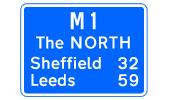
...and convey a complex series of information bytes at a glance (not to mention provide a source of healthy in-car debate)...
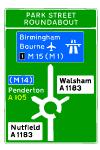
...you don’t see so many of these abroad...

...and who hasn’t spend many a happy mile pondering the physical possibility or otherwise of this little gem:

The Tube Map: Embracing the Abstract
British sign-making reached its apotheosis of course, with the London Tube Map. This is – seriously – perhaps the greatest piece of British design work of the twentieth century
It was created by Harry Beck in 1933. Beck’s genius was to realise that the map could bear only a passing resemblance to geographical reality – and that this would actually make it more useful.
Navigating the Underground is child's play, thanks to Beck’s map. You find your destination, see the line and then it's just a matter of northbound or southbound.
Compare its elegant simplicity with the horrors of the Paris Metro map, which misguidedly attempts to represent physical reality.
So here we have an interesting philosophical point. The French, lovers of the abstract and the ephemeral, fail to create something useful by attempting to be practical.
The down-to-earth British, on the other hand, embrace the abstract to create something practical.
(Incidentally, this is what the London Tube map would look like if it represented physical reality.)
"At the moment all we’re allowed is some hieroglyphics depicting a P, a bed, a knife and fork and so on," complained a suit. "We want to put brands in that space."
The official reason for the outlawing of brand signs all over the motorway is that they might distract drivers.
So far, Saussure
Never mind that, they ought to be banned for aesthetic reasons.
British motorways may be overcrowded, slow, and subjected to constant roadworks, but by thunder we know how to do signs.
British road signs are the most beautiful in the world. Minimal text, maximum efficiency, no sharp edges.
That warm, rounded font can make even the most dismal places seem welcoming...
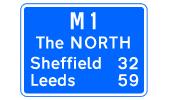
...and convey a complex series of information bytes at a glance (not to mention provide a source of healthy in-car debate)...
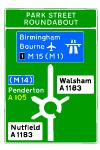
...you don’t see so many of these abroad...

...and who hasn’t spend many a happy mile pondering the physical possibility or otherwise of this little gem:

The Tube Map: Embracing the Abstract
British sign-making reached its apotheosis of course, with the London Tube Map. This is – seriously – perhaps the greatest piece of British design work of the twentieth century
It was created by Harry Beck in 1933. Beck’s genius was to realise that the map could bear only a passing resemblance to geographical reality – and that this would actually make it more useful.
Navigating the Underground is child's play, thanks to Beck’s map. You find your destination, see the line and then it's just a matter of northbound or southbound.
Compare its elegant simplicity with the horrors of the Paris Metro map, which misguidedly attempts to represent physical reality.
So here we have an interesting philosophical point. The French, lovers of the abstract and the ephemeral, fail to create something useful by attempting to be practical.
The down-to-earth British, on the other hand, embrace the abstract to create something practical.
(Incidentally, this is what the London Tube map would look like if it represented physical reality.)
Thursday, May 12, 2005
Last chance to see...?

Ibrahim Ferrer

Missus Think of England and I went to see the 78 year old Cuban singer Ibrahim Ferrer at the Colston Hall last night.
Tall, thin and in trademark suit and flat cap, he hobbles onto the stage and has to be helped with the microphone a fair bit, but phew, what a voice! ...A totally unique sound that can’t have been any stronger or clearer when he began singing in the Havana nightclubs of the 1940s.
He had a whole orchestra of virtuoso Cuban musicians (they hid the hired English session guys on strings at the back of the stage), including a quite astonishing pianist, who at one point hammered the keys so fast his hands were literally a blur.
Ferrer is famous as the singer with the Buena Vista Social Club, discovered/put together by the American musician Ry Cooder.
If you haven’t seen the film, or bought the album, I can thoroughly recommend them.
The music is instantly loveable: a bit Latin, a bit jazzy, a bit North African, perhaps a touch of slowed-down salsa, and very easy on the ear.
Two hours of hypnotic bliss, and wonderful warmth from the audience, who gave him a series of epic standing ovations.
I don’t suppose we’ll see him again sadly, but you never know. If you get the chance, don’t miss him.
Tuesday, May 03, 2005
Gerrrrindeeerrrr!
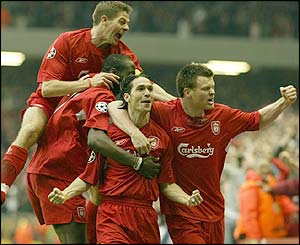
Jamie Carragher.
Eeegor Biscan.
Rafa Benitez.
A quid on Luis Garcia and 1-0 scorecast at 50-1.
A tenner each way back in October on the Mighty Reds to win the damn thing at 25-1.
Mourinho's face.
Best.
Birthday.
Ever.
Monday, May 02, 2005
The Ashes - Summer 2005
Being a personal and very biased record of the much-anticipated Australian tour of England, Summer 2005.
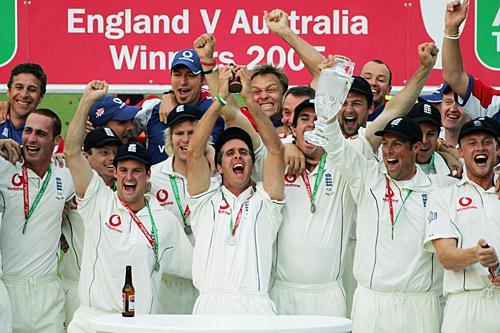
Review
God is an Englishman (the moments that swung it)
The Aussie Aftermath (Aussie player ratings)
England Heroes (England player ratings)
Funnies from the series
Weird science: key series statistics
Nobody told me there'd be days like these (the joy of victory)
Flintoff's Ashes (after Edgbaston)
A commemorative set of stamps is issued
Features
The Aussies and sledging
Poms versus convicts: great Ashes quotes
The Ashes Test Series Results
England win the five match series 2-1
England Player of the Series: Andrew Flintoff
Australia Player of the Series: Shane Warne
Player of the Series: Andrew Flintoff
1st Test
Lord's, London
21-24 July 2005
Result: Australia won by 239 runs
Toss: Australia, elected to bat
Man of the Match: GD McGrath
Full scorecard
2nd Test
Edgbaston, Birmingham
4-7 August 2005
Result: England won by 2 runs
Toss: Australia, elected to bowl
Man of the Match: A Flintoff
Full scorecard
3rd Test
Old Trafford, Manchester
11- 15 August 2005
Result: Match Drawn
Toss: England, elected to bat
Man of the Match: RT Ponting
Full scorecard
4th Test
Trent Bridge, Nottingham
25-28 August 2005
Result: England won by 3 wickets
Toss: England, elected to bat
Man of the Match: A Flintoff
Full scorecard
5th Test
Kennington Oval, London
8-12 September 2005
Result: Match Drawn
Toss: England, elected to bat
Man of the Match: KP Pietersen
Full scorecard
Warm-ups and One-dayer highlights
England beat Australia in the first home international Twenty20 game. Rose Bowl, 13 June.
Somerset beat Australia. Taunton, 15 June
Bangladesh beat Australia. Cardiff, 18 June
Aussie all-rounder Andrew Symonds fined and suspended for naughty behaviour
England beat Australia. Bristol, 19 June
The Natwest Traingular Final is between England and Australia at Lords on 2 July and ends, absurdly, in a tie as Ashley Giles scrambles the required 2 off the last ball.
In the three-match Natwest Challenge series, with its supersubs etc, Australia jammily win the last two games, but England gloriously win the first by a record 9 wickets.
Ashes Links
Cricket365 Ashes special - tons of analysis, funnies, pics etc
Cricinfo - round-up, summary and stats - best for stats, plus a great photo archive
BBC News round-up
Channel 4 special report
Subscribe to:
Posts (Atom)