
Wednesday, October 26, 2005
Carry on up the Canary Islands


Tuesday, October 25, 2005
A Confederacy of Dunces
The Palestinian-born wife of George Galloway, the Respect MP, is accused today of receiving $149,980 (about £100,000) derived from the United Nations Iraqi oil-for-food programme.
A report by an investigative committee of the United States Senate says the money was sent to the personal account of Amineh Abu Zayyad in August 2000.
The report includes bank records showing a paper trail from Saddam's ministries to Mrs Galloway. It states that the Iraqis handed several lucrative oil-for-food contracts to the Jordanian businessman Fawaz Zureikat, an old friend of the Galloways. A month later, on Aug 3, 2000, Mr Zureikat allegedly paid $150,000 minus a bank commission of $20 from his Citibank account number 500190207 into Mrs Galloway's account at the Arab Bank in Amman.
The senate team also says that a $15,666 payment had been made on the same date to a Bank of Scotland account belonging to Mr Galloway's spokesman, Ron McKay. Last night Mr McKay said he had no recollection of the alleged payment.
The oil-for-food programme was designed to help Iraq's needy but was misused by Saddam to reward friends and allies.
And here's a couple from the BBC:
UN report deals serious damage
Each time Paul Volker delivers one of his interim reports, the United Nations receives another body blow and its tarnished reputation suffers yet again.
This was the third of Mr Volcker's reports and in many ways the most damning yet. Until now there was the strong whiff of scandal, but no direct blame.
This report, though, pointed the finger straight at the former head of the oil-for-food programme, Benon Sevan. It concluded that Mr Sevan "corruptly benefited" from his role with the UN - that he had received kickbacks worth almost $150,000 from a small company called Amep, who he had helped profit from the sale of Iraqi oil.
Mr Sevan denies the allegation and insists he received that money from his aunt.
The Annans: Story of a father and son
UN Secretary General Kofi Annan must have hoped that a March 2005 report into the Iraqi oil-for-food programme would help put his ship back on an even keel - but it turns out there are still squalls ahead.
The report effectively cleared him of corruption, saying there was "no evidence" of "improper influence by the secretary general in the bidding or selection process" under which the Swiss company Cotecna was chosen to run the programme.
But three months later, new memos have surfaced which appear to suggest that a top Cotecna executive not only met Mr Annan days before the firm won the UN contract - but that he told colleagues their firm could "count on the support" of Mr Annan's "entourage".
That may muddy the conclusions drawn by the earlier report, which found that the evidence was "not reasonably sufficient" to show that Mr Annan had known about the Cotecna bid which came when his son, Kojo, was employed by the company.
Even that report found him guilty of complacency. The chairman of the inquiry, Paul Volcker, a former chairman of the US Federal Reserve, said there had been an "inadequate" investigation by Mr Annan's office into the links between Kojo and Cotecna after it was given the contract.
The problem for Mr Annan, the report found, was that his own son did not tell him the truth. It turned out that Kojo's employment by Cotecna as a "consultant" in fact continued after the contract was granted.
Now Galloway may have known nothing about the money, Annan may have known nothing about who his son worked for, and Sevan may have got the money from his aunt.
But why isn’t Michael Moore making a film about this? There’s so much suspicion of corruption, nepotism and whitewashing to hand that he’d barely need to pad it out with the usual insinuation, out-of-context quoting, pointless stunts and bullying interviews with vulnerable/senile/grief-stricken subjects.
Except that isn’t an interesting question. Moore is just a dunce. The interesting question is, why is there a Confederacy of Dunces?
How did it come to be that people will believe any old rubbish so long as it hints at American imperialism or corruption and conspiracy in the black heart of the Bush administration (try this one on your friends: “of course, they only started the war so that McDonald’s could open up a chain in Baghdad”), yet Kofi Annan enjoys the beatific status of a Nelson Mandela, a Mahatma Gandhi or a Princess Diana, while the bodged and fudged pronouncements of the UN, the committee to end all committees, are treated as if they come on tablets of stone from Mount Sinai?
How did it come to be that this year’s recipients of the Nobel prizes for Peace and Literature were respectively the useless but American-baiting head of United Nations nuclear agency Mohamed ElBaradei, and one Harold Pinter?
And above all, how did the belief that the military removal of a genocidal dictator was unjustified and immoral become not only widely held by many otherwise sane people, but passionately, even rabidly, argued, protested and demonstrated about?
Christopher Hitchens poses this question in his barnstorming essay Democratization, Iraq: A War to Be Proud Of:
This state--Saddam's ruined and tortured and collapsing Iraq--had met all the conditions under which a country may be deemed to have sacrificed its own legal sovereignty. To recapitulate: It had invaded its neighbors, committed genocide on its own soil, harbored and nurtured international thugs and killers, and flouted every provision of the Non-Proliferation Treaty. The United Nations, in this crisis, faced with regular insult to its own resolutions and its own character, had managed to set up a system of sanctions-based mutual corruption. In May 2003, had things gone on as they had been going, Saddam Hussein would have been due to fill Iraq's slot as chair of the U.N. Conference on Disarmament. Meanwhile, every species of gangster from the hero of the Achille Lauro hijacking to Abu Musab al Zarqawi was finding hospitality under Saddam's crumbling roof.
One might have thought, therefore, that Bush and Blair's decision to put an end at last to this intolerable state of affairs would be hailed, not just as a belated vindication of long-ignored U.N. resolutions but as some corrective to the decade of shame and inaction that had just passed in Bosnia and Rwanda. But such is not the case. An apparent consensus exists, among millions of people in Europe and America, that the whole operation for the demilitarization of Iraq, and the salvage of its traumatized society, was at best a false pretense and at worst an unprovoked aggression. How can this possibly be?
How indeed? In Old Europe, the answer is easy. Anti-Americanism is prevalent enough to be scarcely worth commenting on. In a way, you can hardly blame the French since their media is so overwhelmingly Yankophobic that when the statue of Saddam came toppling down so soon into the campaign there was widespread bewilderment among the French public, who had been continually told that the Coalition was being routed on a daily basis and was being sucked into a ‘quagmire’ to make Vietnam look like a tea-party.
So much for the Europeans, but what about the Not-in-my-name Britons?
In February 2003 a million or so people marched through London in protest against the invasion of Iraq. Why were they protesting against it? Since we already knew what a hell-hole Iraq was, the only conceivable rational arguments could be:
(1) Maintaining the official legal superiority of the UN is more important than any benefits of a military action carried out without the official sanction of the UN;
(2) A war is the worse of two evils, in that the benefits of removing from power a genocidal dictator and introducing democracy to Iraq are outweighed by the blood that will inevitably be shed in a military action that includes bombing and fighting in civilian areas. (This could be further justified by a claim that Saddam could somehow be removed and democracy somehow be given to Iraq peaceably, though nobody seemed to come up with a practical suggestion).
Given this, you might have expected the Great March to be a sombre affair, comprising a set of deeply troubled and deep-thinking people rationally but reluctantly plumping for one bloody evil over another, and supplemented perhaps by a small band of bespectacled legal-technicality nerds swayed by argument (1).
Except it wasn’t. It was a big old jolly face-painted, horn-tooting, whistle-blowing, sing-along street party, led by the usual intellectually-challenged pop stars and made up mostly of Guardian-toting middle-class weekend-warriors too posh to go to the annual May Day riot, and not posh enough to join in with the Countryside Alliance’s jamboree*.
What fun they had, and how indignant they were, how scandalised that Tony Blair barely batted an eyelid at this singular demonstration of the madness of crowds. This is a democracy, why won’t he listen to the people? Bush’s poodle!**
Somehow sane argument got drowned in a Leftist soup of stupidity that has been bubbling up for years. The basic ingredients include a lingering colonial guilt, and more insidiously, a lame-brained cultural relativism that amounts to: “Who are we to judge their culture? Democracy is just a white western construct – these Iraqis are used to tyranny and torture, you know, like wearing burkhas and driving on the other side of the road.” It’s a short hop from the “who are we to say we’re right and they’re wrong?” argument to the “they are right, we’re wrong” one. There’s a certain self-flagellating element in western culture that loves nothing more than to hear that it’s been wicked. Maybe we should blame it on the Fall.
And of course there’s the baggage that comes with Bush: the cringeworthy attempts at public speaking, the little ‘doubleya’ to distinguish him from Daddy, the Born-Again babble. That puke-inducingly predictable gem “my favourite philosopher is Jesus Christ.” And neither he nor Blair can escape blame for the bungled way they presented the case for war, nor for the lack of planning for handling the aftermath. Too much waffle about WMDs, too much banging on about 9/11. It would have been far better to concentrate on the failure of the UN to effectively do anything about this horrible man Saddam and his wrecked country.
Even so, chuck all these things in one side of the scales and it will barely register against the long-term benefits for Iraqis of a Saddam-free world, which should surely have been obvious to anyone with eyes to see.
Despite the doom-saying of the French, the rantings of Galloway, and despite the so-called ‘insurgents’ (‘insurging’ against what? The word is ‘criminals’) continuing to blast pathetically away at the newly-fledged citizens of Iraq, those citizens have nonetheless managed to create in record time a constitution and the basis for a democracy.
Which is how history will remember the great Iraqi adventure: as the imperfect but ultimately successful removal of a bloody tyrant, and the creation of a new democratic state. Sanity usually peeps through in the end. There are still protestors, but ultimately you need something to protest against, and the active ones have dwindled to a bunch of oddballs saying nothing much more than Father Ted’s “Down with this sort of thing”.
There remains however, a massive Left-wing resentment of Bush’s war, and an unhealthy eagerness to portray every setback as a disaster, and every step forward as inadequate. But that is what happens when your television screens and your fashionable politics are controlled by a Confederacy of Dunces.
(*Nothing personal, you understand. Some of my best friends are Guardian-toting weekend-warriors. But madness is madness).
(**Although funnily enough, polls a few days before the invasion found a majority of the British public in favour of the war, as the pull of British patriotism is so strong when the military actually gear up to go, that it overrides even the madness of crowds. A couple of years later, Blair won a general election, with the equally pro-war Tories making gains and the LibDems singularly failing to cash in on their supposed anti-war trump card, but by this time everyone had switched to Making Poverty History anyway).
Please sir, I appear to have lost the will to live
An Indian has taught a marathon non-stop, no-sleep English grammar class for three days to 60 students in the city of Mumbai (Bombay).
Sanjay Kumar Sinha taught for 73 hours and 24 minutes in an attempt to get into the Guinness Book of Records for the longest lesson.
Three days? We used to measure out Latin lessons in decades.
Friday, October 21, 2005
Never mind Nelson, what happened to poor Basto?
The first is from 7 November 1805, which carries the first report of the Battle of Trafalgar (three weeks after the event), and the second dates from 10 January 1806, with an account of Nelson’s funeral.
The Trafalgar issue was a ground-breaker in that it was the first edition of the paper to carry a story on the front page. Three of the four columns normally reserved for adverts were swept aside to allow room for Vice-Admiral Collingwood’s highly exciting account of the battle. The style could be straight out of one of Patrick O’Brian’s wonderful Aubrey/Maturin novels.
(You can read Collingwood’s report in full, as it was reproduced in the The London Gazette Extraordinary, here.)
But what really amuses me is the front-page juxtaposition of the report of this uniquely significant battle, which changed the course of history for all three of the nations involved, with the homely small ads that remain in the left-hand column.
Two of the gems include:
A FINE MARE to be SOLD, the property of a Gentleman, warranted sound; walks, trots, gallops and leaps remarkably well. To prevent trouble, the price is 40 guineas. Trial allowed
and the very poignant:
LOST, an OLD POINTER DOG, white with red spots, answers to the name of BASTO; almost blind, one eye quite gone.
Any person bringing the said Dog to No. 158, Swallow-street, Piccadilly, shall receive ONE GUINEA Reward, and reasonable expences paid. – N.B. No greater Reward will be offered.
Thursday, October 20, 2005
Run away!
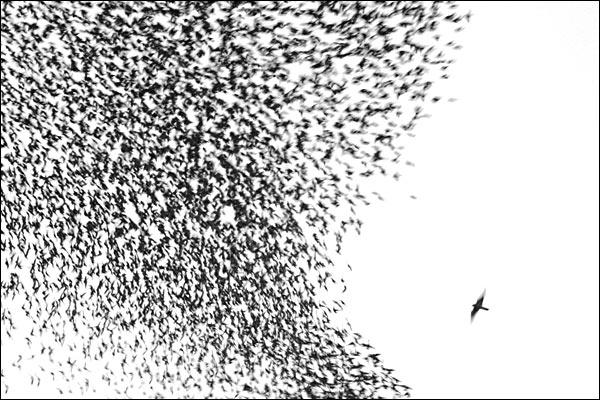
This amazing and romantic picture shows a solitary peregrine falcon sending a flock of starlings into turmoil. It won the Wildlife Photographer of the Year award for Manual Presti.
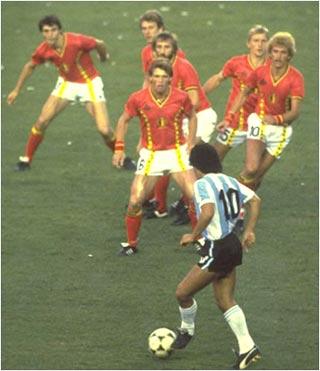
It immediately reminded me of something, but it took a while to remember what exactly. then I realised it was my favourite sporting photograph....
What kind of fascist oppressive regime won't let a man experiment with the materials required for germ warfare
The Guardian gives us this jaw-droppingly absurd story:
On May 11 2004 Steve Kurtz awoke to find his wife dead beside him. He would come to refer to this date as "5/11"; it was the day his life took a Kafkaesque turn. When paramedics arrived at his house in Buffalo, New York State, they noticed a makeshift laboratory on an upstairs landing, with an incubator full of toxic-looking bacteria, and alerted the police.
Kurtz assured them his lab was, in effect, his studio; that he was an internationally recognised artist, as well as an art professor at the University at Buffalo, who used molecular biology in his work…. They thought I'd germed her to death," Kurtz says. An autopsy later showed that Hope, his partner of 27 years, had died of heart failure in her sleep.
The day after the death, however, when Kurtz returned from the funeral home, three car-loads of FBI agents were waiting for him. He was now suspected of bio-terrorism. His house was quarantined with yellow police tape. In what became a media spectacle ("Bioterrorism Blunder?" asked NBC news), five regional branches of the FBI, the Joint Terrorism Task Force, the Department of Homeland Security, the Department of Defence, the Buffalo police, fire department, and state marshall's office swarmed over Kurtz's home. They were protected by white chemical suits and wore breathing apparatus…..
Last June a federal grand jury was convened to evaluate bio-terrorism charges against Kurtz. He was indicted, but not under the biological weapons anti-terrorism act. He and Robert Ferrell, a professor of human genetics at the University of Pittsburgh, were charged with mail and wire fraud, accused of colluding to illegally furnish Kurtz with $256 (£146) of harmless bacterial cultures. The crime carries a sentence of up to 20 years. Kurtz's lawyer, Paul Cambria (who defended pornographer Larry Flynt against obscenity charges), is arguing the case should be thrown out of court. The government's "paranoid over-reaction" is, he says, a political attack on Kurtz's subversive art.
The artistic community has rallied to the cause, staging protests and organising an auction - with work donated by 50 artists, including Richard Serra, Hans Haacke, Cindy Sherman, Mike Kelly and Sol LeWitt - that raised $170,000 (£97,000) for his defence. His case has not yet come to trial but Kurtz has already become, as the New York Times put it, "an unlikely art world martyr-hero". Perhaps, as a sticker on his fridge puts it, he might be better described as a "prisoner of art".
In 1986, Kurtz and his wife co-founded Critical Art Ensemble (CAE), a small artists' collective "dedicated to exploring the intersections between art, technology, radical politics and critical theory".
In CAE's most recent manifesto, Molecular Invasion, Kurtz encourages his readers to carry out other acts of "fuzzy biological sabotage". "The fuzzy saboteur," the book declares, "has to stand on that ambiguous line between the legal and the illegal (both criminally and civilly), in areas that have not yet been fully regulated." The reader is advised to avoid direct sabotage, such as arson, in favour of "pranks". Cues are taken from the CIA - their lacing of Fidel Castro's cigars with LSD is considered model behaviour. One idea is to release genetically mutated and deformed flies in biotech research facilities and nearby restaurants to stir up paranoia.
When the FBI raided his house, Kurtz was researching the history of germ warfare for a new project. He was growing simple types of bacterial cultures, routinely used in high-school biology classes, that could also be used to simulate the mushrooming of anthrax and plague.
Over some steak Kurtz tells me that his persecutors "have to have something to show for the millions of dollars they've spent on this. They're trying to create a kind of hysteria, a horrible kind of vigilantism. It's right out of Hitler's handbook. The final goal is to silence and intimidate voices of dissent."
Ah yes, the good old ‘Bushitler’ argument.
When such prize boobies as Steve Kurtz say things like "it's right out of Hitler's handbook", and "the final goal is to silence and intimidate voices of dissent", not only does he defeat his own argument merely by the fact that he can state it, but he insults the memories of the thousands of people who really did die or suffer because of Nazism, and the millions more today who genuinely live under tyranny and repression.
Friday, October 14, 2005
Thursday, October 06, 2005
TofE would like to beat the rush and wish you all a Happy Christmas now
'It's Christmas," Noddy Holder used to scream. But if memory serves, that ghastly record only came out about a week before the big day in 1973 (and then shot to the top of the charts). Noddy probably wouldn't have thought of marking Christmas in the balmy days of early October - but that was then. In 2005, Christmas starts NOW.
Pope Benedict XVI, the Archbishop of Canterbury and other fuddy duddies no doubt think Christmas should start, at the very earliest, in early December, with small, tousle-haired children lighting advent calendars in freezing churches. But somebody far more important - the boss of global superpower Tesco - has decided that it should start just as the cricket season ends.
My top 5 of Traditional British Things That Everyone Moans About In Exactly the Same Way Every Year But Which Never Change and Never Will
5. The Clocks Go Back to GMT in October and it’s Too Dark When You Leave Work
4. Tim Henman Fails to Win Wimbledon (this will soon be replaced by Andy Murray Fails To Win Wimbledon)
3. They Enforce a Hosepipe Ban in July Even Though it’s Rained Every Bloody Day Since Last November
2. The Great GCSEs/A-Levels Are Getting Easier versus Standards Are Improving Debate
1. The Shops Start Selling Christmas Stuff Before Halloween and Guy Fawkes Night
Snake oil for the many, not the few
Complementary therapies should be given a greater role in the NHS, a report commissioned by the Prince of Wales is set to say.
The report, by economist Christopher Smallwood, will say patients with conditions such as back pain and stress can benefit from some of the therapies.
However, there is a shortage of treatments such as acupuncture and osteopathy in poor areas, it will say.
Prince Charles, an enthusiast for alternative medicine, commissioned the independent economist to compile the report nine months ago...
Poor old Prince Charles. If there is a prize buffoon anywhere in the world, Charles is that prize buffoon.
There is no such thing as 'alternative medicine'.
There is medicine that works, and medicine that doesn’t work.
Or to put it another way, there is medicine and there is quackery.
There’s nothing secretive or elitist about what counts as medicine: if it can be shown to work in a properly conducted double-blind test, literally anything is allowed in. And then it is no longer ‘alternative’.
If it can’t, it should have nothing to do with the NHS. Anecdotes are not tests.
Tuesday, October 04, 2005
English as she is spoke
Created in 1885 by José da Fonseca and Pedro Carolino, it was intended as a Portugese-English conversational guide. However, the Portugese authors chose to go about creating it in an unusual manner.
Having already created a Portuguese-French phrasebook some years earlier, they decided to translate it into a Portugese-English phrasebook. Unfortunately, all they had to go on regarding the English side of things, was a French-English dictionary.
The results are wonderful. We are introduced to such handy phrases as: “Have you forgeted me?” and "They fight one's selfs together". Not to mention the indispensible "These apricots and these peaches make me and to come water in the mouth."
We learn that an English gentleman, perhaps a “Porkshop-keeper” by trade, might get up, put his “buskins” on “the fat of his leg”, and go to visit his “quater-grandmother”, all the while pondering to himself the truth of the phrase: “A horse baared don't look him the tooth.”
We are also given some typical English dialogue:
To Inform One'self of a Person:
How is that gentilman who you did speak by and by?
Is a German.
I did think him Englishman.
He is of the Saxony side.
He speak the French very well.
Tough he is German, he speak so much well italyan, french, spanish and english, that among the Italyans, they believe him Italyan, he speak the frenche as the Frenches himselves. The Spanishesmen believe him Spanishing, and the Englishes, Englishman. It is difficult to enjoy well so much several languages.
Mark Twain said of the book:
It is not a fraud who speaks in the following paragraph of the author's Preface, but a good man, an honest man, a man whose conscience is at rest, a man who believes he has done a high and worthy work for his nation and his generation, and is well pleased with his performance:
"We expect then, who the little book (for the care what we wrote him, and for her typographical correction) that may be worth the acceptation of the studious persons, and especially of the Youth, at which we dedicate him particularly."
You can find read more about the fine book here. And the full text is available here.
I think if I was an evil scientist, I might be tempted to see what would happen if I kidnapped an infant and educated him solely using English as she is spoke for language, William McGonagal for poetry, 1066 And All That for history, and the films of Ed Wood for culture.
And before anyone says, ‘George W Bush’, I’ve said it first.
The story of the moral
Friday, September 30, 2005
The Emperor’s Brand New Leopard-Skin Pill-Box Hat?

Watching No Direction Home on Tuesday and Wednesday this week - Martin Scorcese’s epic but hypnotic documentary about Bob Dylan’s career up to 1966 – was an eye-opener.
I’ve always known (and loved most of) the songs, but known virtually nothing about the man. The picture you get is that Dylan is a rare thing – a genuine enigma.
Virtually everything he says is a quite absurd, profound-sounding epigram that flutters on the edge of meaning something, though you’re not quite sure what. But at the same time he couldn’t be described as pretentious because he’s not pretending and he isn’t bothered about impressing anyone.
Several things struck me while watching the film. The first is that, as a person, nobody’s ever ‘got’ him, ever. Because of a few anthemic songs (Blowin’ in the Wind, The Times They Are A-Changing etc), his love of Woody Guthrie and his sympathy with the civil rights movement, he is held up as the darling of the folkie Left protest scene.
But, no matter how much he is cajoled by the likes of Pete Seeger and Joan Baez, he never turns up to any of the protests.
He is utterly indifferent to politics. Of Pete Seeger’s blacklisting, Dylan says “I guess I heard he was a Communist, I don’t know. I didn’t really know what a Communist was.” One of his contemporaries says “We thought Dylan was hopelessly politically naïve. But with hindsight maybe he was much smarter than we were.”
There’s a lot of footage of his 1966 tour, just after he infamously ‘turned electric’. The folk-loving audience, who’ve paid to see him, boo continuously throughout his set. One guy shouts out “Judas!” But Dylan barely flinches. He just carries on playing even louder with his band.
Dylan does what Dylan does, and if anybody else likes it, good. If not, Dylan does it anyway.
The best bits however, come in footage from various press conferences as he tours the world. He sits there all by himself while journalists ask him ever more ridiculous questions. One chap presses him to explain the spiritual significance of the motorcycle T-shirt he’s sporting on the cover of Highway 61 Revisited. “It’s just a T-shirt I happened to be wearing when they took the photo, man.”
Another drongo asks him: “How many protest singers are there following on from you, in America?”
“136” says Dylan, perfectly deadpan.
“136? Is that, is that an exact figure?” asks the hack, uncertainly.
“Actually, it could be 142.”
Time and again he’s given the opportunity to blow his own trumpet, to declare his own genius, to explain how his lyrics are insights into profound truths about the Human Condition.
But he’s just not interested.
So is it a case of the Emperor’s New Clothes? Is there nothing there at all behind the bizarre poetry?
I don’t think you could call honestly it empty.
‘My love, she speaks like silence’ isn't empty, it's Byronic. It could have been Coleridge dreaming about dancing beneath the diamond sky with one hand waving free, silhouetted by the sea.
He just seems to pull lines like “How many roads must a man walk down, before you call him a man?” out of the ether, and then be as surprised as everyone else that he’s done so.
The best description I could think of, watching No Direction Home, was idiot savant.
Balking the end half-won...*
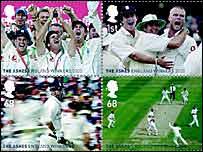
It seems that, not content with bringing out a set of stamps to commemorate the Ashes victory, they've gone and made two of them 68p.
Which is how much it costs to send a letter to Australia.
Now I'm the last person to complain about excessive gloating, but I can't shake the uneasy feeling that somehow, someday, we're going to pay for all this....
*....for an instant dole of praise.
From England's Answer by Rudyard Kipling
Thursday, September 29, 2005
Site update
Click on the wee envelope at the bottom right of each post for the technical wizardry to take effect.
I could murder for a nice cup of Rosie Lee
Traditional tea drinkers have reached boiling point over the state of the nation's cuppa, saying the standard of preparation is a disgrace and the taste so poor that the resulting brew often has to be thrown away.
A cup of tea in most public places is a "complete rip off", say the majority of over-50s, with the biggest gripes being paper or plastic cups, poor quality tea, tea bags with "silly little strings attached", plastic stirrers, and "awful little cartons of long-life milk".
But while British cafes and tea rooms are rated poorly, France emerges as the country that makes the worst tea in the world. Spain also gets the thumbs down, as does America - which many think has never learned the art of tea-making - the Greek Islands, and Italy.
...
Valery McConnell, the editor of Yours magazine, which commissioned the survey among 2,000 of its readers, average age 67, said: "The art of making the great British cup of tea has been lost and the tea-loving over-50s have reached boiling point at the downgrading of their favourite beverage.
"The rise of American and continental style coffee chains has also brought with it American and continental-style tea - and we all know how that tastes."
…. On average every person in Britain drinks three cups of tea a day.
It also points out that when taken with milk, as is the preference of 98 per cent of the population, four cups of tea a day provide significant amounts of the recommended levels of nutrients, including calcium, zinc, folic acid, vitamins B2, B1 and B6, manganese and potassium.
Three cups a day? That average must include all those who never drink it, since I know few tea drinkers who don’t have at least six.
When venturing abroad, we all know that a healthy supply of PG Tips should go into the suitcase before even the sun-tan lotion. The Germans are ok at providing ‘Tee mit Milch’, but everyone else is clueless.
In America I’ve experienced two amusingly different reactions. One very nice lady serving the coffees at a conference in Chicago got into a terrible fluster when she found that there was a Briton in the group. “Tea! We need to get you some tea! Oh my God, we haven’t got any tea!” – as if I was genetically incapable of consuming coffee. I hadn’t even asked for tea.
The other reaction that I’ve had in several diners and cafés when requesting tea with milk was an ‘eyes-to-heaven-is this guy for real?-Goddamn Limeys’ look of despair.
As if tea-drinking was an affectation, rather than an addiction.
A truth universally acknowledged, of course, is that nobody else knows how to make a proper cuppa except you.
But what I’ve come to realise about tea is that, unlike most things, which we try to get to taste nice, the ideal cup of tea should taste of nothing. Nada. Zilch. You shouldn’t even notice that you’re drinking it.
It’s just hot, delivers a small quantity of caffeine, breaks up the day into manageable sections, provides an excuse for aimless chatter, allows you to listen to the agreeable sound of a boiling kettle, is something respectable to hold when you’re watching telly, and is a small peace-offering/plea for leniency for builders, electricians, plumbers etc.
That it should taste good is irrelevant.
Indeed, people strive to get it to the right level of neutrality for them. If it’s slightly too bitter, add sugar. Too strong, add more milk. And so on and so on until you can taste absolutely nothing at all, and then you can smack your lips, make that ‘aaaah’ sound, and properly describe it as a ‘nice cup of tea.’
Monday, September 26, 2005
Ashes 2005: Funnies

Funniest moment 1:
As the umpires discussed coming off for bad light on the fourth day of the Final Test, with England wanting to waste time and the Aussies needing all the time they could get, the fans tried to swing the decision. England fans put up umbrellas and peered as if into pitch darkness, while Aussie spectators took off their shirts, squinted into the ‘sun’ and made expansive “phew, too hot!” gestures.
Funniest moment 2:
After the first break for bad light, all the Aussie players returned to the field sporting dark sunglasses.
Funniest moment 3:
Ponting’s foul-mouthed tirade after being run out by sub Gary Pratt.
Funniest moment 4:
Freddie Flintoff’s face on the parade bus, following an all-night drinking session
Most astute crowd chant:
“There’s only one Aussie bowler”. Both a tribute to Shane Warne, and an indictment of the rest of the Australian attack.
Best commentator: Mark Nicholas (Channel 4)
Richie Benaud deserves a mention as he retires from commentary in England, but Mark Nicholas’s smoothie style and penchant for hyperbole came into its own this series. He’ll be missed now that Sky have gobbled up Test cricket.
Best expert: Rod Marsh (BBC Radio)
The archetypal Aussie bloke was an endless source of amusement.