From Simon Barnes, The Times Chief Sports Writer, in Istanbul
FOOTBALL. Bloody hell, the printable expletives are utterly inadequate for the task of summing up a night of football mayhem. Bring out the asterisks: it was a night when football brought us the utterly impossible on a night of perfect insanity as Liverpool won the European Cup final on penalties after doing their best to lose it.
Liverpool produced one of the greatest comebacks in the history of football. They created for themselves an utter disaster and somehow rose to find hope, and with it, power and effectiveness and purpose and direction. They turned a lost match around in six impossible minutes: one of those periods of total enchantment that happen in football, but very rarely.
Yet it seemed that they had managed to lose everything in less than a minute. After a season of ever-growing hope and burgeoning expectation, Liverpool looked as if they had lost the lot in a matter of 50 seconds. They conceded a goal more or less before a Liverpool player had touched the ball and were 3-0 down at half-time. It was humiliation.
But before you could say “Football. Bloody hell” they were back in it again. After being made to look like small-timers and second-raters, they came roaring back as if they were the old champions of the Eighties, the Liverpool side that expected to win European Cup finals as a matter of course. They drew level in that period of magic and took the game into extra time, a spooky period played in a mood close to emotional exhaustion.
The match proper finished at 3-3, but not before Jerzy Dudek had made a remarkable double save from Andriy Shevchenko that suggested the force was with the Pole. Then came the penalties and Dudek, a goalkeeper often and fairly criticised this season, saved two of them, enough for Liverpool to win the shoot-out 3-2.
There was a Liverpool banner in the stadium that bore the legend no passaran — they shall not pass — a tribute to the startling and complete impregnability of the Liverpool defence over the previous three matches in this competition. Plan A was obvious, then: don’t concede a goal and so the favourites will get worried and grow vulnerable.
As plans go, it had a lot going for it, but it was less than a minute before Liverpool were on to plan B. It is the nature of football that things can go very wrong very quickly. Liverpool were a goal behind while still wondering what the opening ceremony was all about.
The goal was simplicity itself. A foul: Djimi Traoré on Kaká. A free kick, and Andrea Pirlo swung it in. Paolo Maldini was supposed to be a weak link at 36, but his legs had not got tired in three quarters of a minute. He hit a spirited right-foot volley and topped the ball rather than met it sweetly.
As so often happens in such circumstances, it crashed into the ground and rose steeply in a fashion that was hard to read. And on this occasion it found the net and Liverpool’s day was ruined before it had rightly started. The Liverpool supporters had out-sung the Milanese before the start: their silence was shocking. It reflected a feeling of deep dismay and it reflected perfectly the dismay of the Liverpool players.
So much for Rafael Benítez, the Liverpool manager, and his sudden recognition as a tactical genius. You can’t fault him for effort, but he was presiding over a disaster at half-time and his ploy of putting Harry Kewell in his starting line-up looked like an act of folly.
They shall not pass, indeed. Liverpool hardly passed at all in the first half. Liverpool had come with a reputation for outstanding defence, Milan showed that the traditional continental virtues of tight, intelligent passing are worth a mention. Shevchenko, in a moment of gliding wit and eventing, set up Hernán Crespo for a tap-in, then Kaká pushed through a sweetly timed pass. This one required a bit more of a finish. Crespo provided it and in the process made Liverpool look like a team playing a little way out of their class.
Then the tide turned in a manner that defied logical and even tactical sense. It was simply as if God had changed sides. The force, long absent, was suddenly with Liverpool. Steven Gerrard was the man who started it with a looping header from a cross by John Arne Riise. Then it was Vladimir Smicer, who had come on as a 23rd-minute substitute for the hapless Kewell. He reduced the deficit to one with the goal that threw Milan into a state of confusion.
So much so that they promptly conceded a penalty and Xabi Alonso put that one away on the rebound. Three goals within six minutes: rout had become fightback and fightback had become epic.

Thursday, May 26, 2005


The beautifullest game

Ridiculous!
3-0 down and dead at half time. 3 goals in 6 mad minutes against the best defence in the world. And a win on penalties!
Sorry, but no other sport can give you a night like that.
Best.
Game.
Ever.
Wednesday, May 25, 2005
Them scousers again
It's the big day.
Luis Garcia is in amazing goalscoring form in Europe, and with Liverpool likely to play with only one striker, with Garcia in support, he's absurdly over-priced.
So my tips are Luis Garcia and 1-0 (40-1 at PaddyPower).
Or why not take a flutter on a real thriller? Garcia and a 3-2 Liverpool win is 175-1. Got to be worth a quid.
Luis Garcia is in amazing goalscoring form in Europe, and with Liverpool likely to play with only one striker, with Garcia in support, he's absurdly over-priced.
So my tips are Luis Garcia and 1-0 (40-1 at PaddyPower).
Or why not take a flutter on a real thriller? Garcia and a 3-2 Liverpool win is 175-1. Got to be worth a quid.
Thursday, May 19, 2005
Signifying nothing
According to the BBC news this morning, motorway service stations are pushing to change rules dating back to the 1950s forbidding the use of adverts on the motorway.
"At the moment all we’re allowed is some hieroglyphics depicting a P, a bed, a knife and fork and so on," complained a suit. "We want to put brands in that space."
The official reason for the outlawing of brand signs all over the motorway is that they might distract drivers.
So far, Saussure
Never mind that, they ought to be banned for aesthetic reasons.
British motorways may be overcrowded, slow, and subjected to constant roadworks, but by thunder we know how to do signs.
British road signs are the most beautiful in the world. Minimal text, maximum efficiency, no sharp edges.
That warm, rounded font can make even the most dismal places seem welcoming...
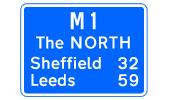
...and convey a complex series of information bytes at a glance (not to mention provide a source of healthy in-car debate)...
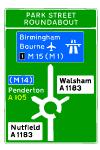
...you don’t see so many of these abroad...

...and who hasn’t spend many a happy mile pondering the physical possibility or otherwise of this little gem:

The Tube Map: Embracing the Abstract
British sign-making reached its apotheosis of course, with the London Tube Map. This is – seriously – perhaps the greatest piece of British design work of the twentieth century
It was created by Harry Beck in 1933. Beck’s genius was to realise that the map could bear only a passing resemblance to geographical reality – and that this would actually make it more useful.
Navigating the Underground is child's play, thanks to Beck’s map. You find your destination, see the line and then it's just a matter of northbound or southbound.
Compare its elegant simplicity with the horrors of the Paris Metro map, which misguidedly attempts to represent physical reality.
So here we have an interesting philosophical point. The French, lovers of the abstract and the ephemeral, fail to create something useful by attempting to be practical.
The down-to-earth British, on the other hand, embrace the abstract to create something practical.
(Incidentally, this is what the London Tube map would look like if it represented physical reality.)
"At the moment all we’re allowed is some hieroglyphics depicting a P, a bed, a knife and fork and so on," complained a suit. "We want to put brands in that space."
The official reason for the outlawing of brand signs all over the motorway is that they might distract drivers.
So far, Saussure
Never mind that, they ought to be banned for aesthetic reasons.
British motorways may be overcrowded, slow, and subjected to constant roadworks, but by thunder we know how to do signs.
British road signs are the most beautiful in the world. Minimal text, maximum efficiency, no sharp edges.
That warm, rounded font can make even the most dismal places seem welcoming...
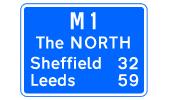
...and convey a complex series of information bytes at a glance (not to mention provide a source of healthy in-car debate)...
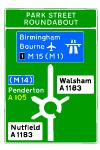
...you don’t see so many of these abroad...

...and who hasn’t spend many a happy mile pondering the physical possibility or otherwise of this little gem:

The Tube Map: Embracing the Abstract
British sign-making reached its apotheosis of course, with the London Tube Map. This is – seriously – perhaps the greatest piece of British design work of the twentieth century
It was created by Harry Beck in 1933. Beck’s genius was to realise that the map could bear only a passing resemblance to geographical reality – and that this would actually make it more useful.
Navigating the Underground is child's play, thanks to Beck’s map. You find your destination, see the line and then it's just a matter of northbound or southbound.
Compare its elegant simplicity with the horrors of the Paris Metro map, which misguidedly attempts to represent physical reality.
So here we have an interesting philosophical point. The French, lovers of the abstract and the ephemeral, fail to create something useful by attempting to be practical.
The down-to-earth British, on the other hand, embrace the abstract to create something practical.
(Incidentally, this is what the London Tube map would look like if it represented physical reality.)
Thursday, May 12, 2005
Last chance to see...?

Ibrahim Ferrer

Missus Think of England and I went to see the 78 year old Cuban singer Ibrahim Ferrer at the Colston Hall last night.
Tall, thin and in trademark suit and flat cap, he hobbles onto the stage and has to be helped with the microphone a fair bit, but phew, what a voice! ...A totally unique sound that can’t have been any stronger or clearer when he began singing in the Havana nightclubs of the 1940s.
He had a whole orchestra of virtuoso Cuban musicians (they hid the hired English session guys on strings at the back of the stage), including a quite astonishing pianist, who at one point hammered the keys so fast his hands were literally a blur.
Ferrer is famous as the singer with the Buena Vista Social Club, discovered/put together by the American musician Ry Cooder.
If you haven’t seen the film, or bought the album, I can thoroughly recommend them.
The music is instantly loveable: a bit Latin, a bit jazzy, a bit North African, perhaps a touch of slowed-down salsa, and very easy on the ear.
Two hours of hypnotic bliss, and wonderful warmth from the audience, who gave him a series of epic standing ovations.
I don’t suppose we’ll see him again sadly, but you never know. If you get the chance, don’t miss him.
Tuesday, May 03, 2005
Gerrrrindeeerrrr!
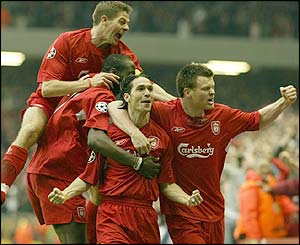
Jamie Carragher.
Eeegor Biscan.
Rafa Benitez.
A quid on Luis Garcia and 1-0 scorecast at 50-1.
A tenner each way back in October on the Mighty Reds to win the damn thing at 25-1.
Mourinho's face.
Best.
Birthday.
Ever.
Monday, May 02, 2005
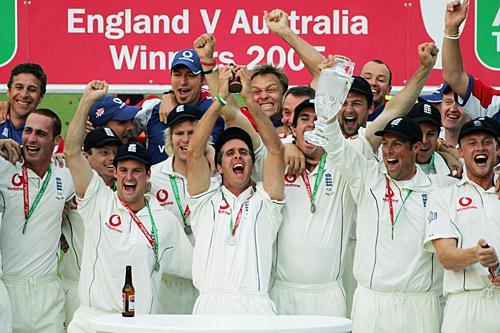
The Ashes - Summer 2005
Being a personal and very biased record of the much-anticipated Australian tour of England, Summer 2005.
Review
God is an Englishman (the moments that swung it)
The Aussie Aftermath (Aussie player ratings)
England Heroes (England player ratings)
Funnies from the series
Weird science: key series statistics
Nobody told me there'd be days like these (the joy of victory)
Flintoff's Ashes (after Edgbaston)
A commemorative set of stamps is issued
Features
The Aussies and sledging
Poms versus convicts: great Ashes quotes
The Ashes Test Series Results
England win the five match series 2-1
England Player of the Series: Andrew Flintoff
Australia Player of the Series: Shane Warne
Player of the Series: Andrew Flintoff
1st Test
Lord's, London
21-24 July 2005
Result: Australia won by 239 runs
Toss: Australia, elected to bat
Man of the Match: GD McGrath
Full scorecard
2nd Test
Edgbaston, Birmingham
4-7 August 2005
Result: England won by 2 runs
Toss: Australia, elected to bowl
Man of the Match: A Flintoff
Full scorecard
3rd Test
Old Trafford, Manchester
11- 15 August 2005
Result: Match Drawn
Toss: England, elected to bat
Man of the Match: RT Ponting
Full scorecard
4th Test
Trent Bridge, Nottingham
25-28 August 2005
Result: England won by 3 wickets
Toss: England, elected to bat
Man of the Match: A Flintoff
Full scorecard
5th Test
Kennington Oval, London
8-12 September 2005
Result: Match Drawn
Toss: England, elected to bat
Man of the Match: KP Pietersen
Full scorecard
Warm-ups and One-dayer highlights
England beat Australia in the first home international Twenty20 game. Rose Bowl, 13 June.
Somerset beat Australia. Taunton, 15 June
Bangladesh beat Australia. Cardiff, 18 June
Aussie all-rounder Andrew Symonds fined and suspended for naughty behaviour
England beat Australia. Bristol, 19 June
The Natwest Traingular Final is between England and Australia at Lords on 2 July and ends, absurdly, in a tie as Ashley Giles scrambles the required 2 off the last ball.
In the three-match Natwest Challenge series, with its supersubs etc, Australia jammily win the last two games, but England gloriously win the first by a record 9 wickets.
Ashes Links
Cricket365 Ashes special - tons of analysis, funnies, pics etc
Cricinfo - round-up, summary and stats - best for stats, plus a great photo archive
BBC News round-up
Channel 4 special report
Tuesday, April 26, 2005
Myths of the box
AA Gill – who writes restaurant and television reviews, among other things, in the Times – is always worth a read. Deliberately provocative, he is often preposterous and usually he is unreasonably cruel.
But sometimes he hits the nail on the head, as with this piece in the Sunday Times, stemming from a review of a programme about the history of ‘reality TV’:
Two of the myths of the box are that everybody watches television and that everybody wants to be on television. We know this because everyone on television tells us so. I’ll Do Anything to Get on TV (Sunday, C4) was an examination of the public on the box.
The producers had started from the present glut of reality shows and looked back to see where on earth they had all come from. The great culprit, or mould-breaker, depending on how egocentric you are, was Esther Rantzen’s That’s Life, with its jolly women’s-magazine mix of draconian consumer justice and softly ridiculing vox pops.
Tristrams (Gill’s term for trendy but ignorant TV execs - Ed) assume that television has, democratically, finally given the audience access to the magic box, but this is looking at it all the wrong way round.
Television started as wireless with pictures. Radio had always been a populist medium that used listeners to help make programmes, and the origins of the countless reality shows on TV are the radio programmes of the 1930s and 1940s. Sound broadcasting invented three types of entertainment that couldn’t be done in any other medium: the quiz show, rolling drama and the use of amateurs to talk directly to the audience. Television inherited them, and almost immediately made quizzes and soap operas the defining programmes of the new medium.
Yet it took much longer for reality shows to get to the box, simply because the technology made it too difficult for people who weren’t rehearsed to appear on television. Big Brother, Wife Swap, Faking It and Airport are possible only because of small digital cameras and microphones. Most programme innovations start off as a new bit of kit.
The other reason there are so many reality shows now is that they are cheap. The public comes cheap. All that retrospective, self-serving guff about not patronising the audience that handfuls of Tristrams came out with on this documentary was simply making a faux morality out of reality. Nothing on television has been as patronising of the contestants and the audience as Big Brother or the cattle markets of talent shows. What has changed is that a natural diffidence has been replaced by ratings-grabbing rudeness.
The great misconception about real people on television is that the professionals who present programmes aren’t real in the same sense that the audience is. But they all began as anonymous members of the public, desperate to get their face on the box. Rantzen, the grandmother of reality television, was a secretary who pushed herself forward. Her husband, Desmond Wilcox, who made the reality show Man Alive, was a tabloid hack.
There is no identifiable difference between Simon Cowell and the kids he castigates, apart from 20 years and a couple of million pounds. Davina McCall was a model-agency booker, and is no different from the Big Brother contestants.
People who appear on television, whether as a career or just for a reality moment, are all a type. They would like to believe everyone else wants to do what they do. They need their exhibitionism, embarrassment and insecurity validated by the comfort of believing that we’d all do it if we could. To a man and a woman, people on television are bungee jumpers. They would leap off a crane, tied by elastic, and many of them would do it naked. In fact, bungee jumping ought to be the first lesson on electronic journalism and media courses. If you can’t do it, don’t apply: you’re not cut out for a life in front of the camera. Most of us aren’t and wouldn’t want to be.
The other mythic truth of television — that we’re all watching all the time — is also untrue. At its height, the number of viewers watching Big Brother was smaller than of those watching most early-evening soaps. No reality TV gives the viewers more power over what they see; members of the public are yet to be allowed to be producers, directors or editors. I’ll Do Anything... was a programme that started out with a good idea, but failed to ask the right questions and didn’t think anything like hard enough. It ended up as another overlong, formulaic cutting-and-soundbite lazy doc, a genre even more insidious than reality.
That we all want to be ‘celebrities’, in the new definition of ‘anyone who is on telly for any reason’, is certainly a myth. Audiences like gawping at reality TV contestants because they’re freaks, not because they’re normal. They do it with contempt and disdain, not with admiration or envy.
These ‘100 Greatest’ things are getting out of hand too. 100 Greatest Comedy Sketches, Sitcoms, Soap Stars, TV Villains, Embarrassing Moments etc etc.
Endlessly recycling the same clips of Del Boy falling through the bar, Basil Fawlty whacking his car with a branch, kids on space hoppers and Gazza crying in Italia 90, with the same Z-list talking heads making inane and unfunny comments.
There’s one on practically every week, so soon there’ll be more than enough for ‘The 100 Greatest 100 Greatest Shows’, followed eventually by ‘The 100 Greatest 100 Greatest 100 Greatest Shows’ and so on ad infinitum with Z-list talking heads reminiscing about previous Z-list talking heads reminiscing about previous ‘100 Greatest 100 Greatest Shows’. “Oh yeah, I remember that time we voted Del Boy falling through the bar as the ‘Third Greatest Winner of the 100 Greatest Comedy Sketches’ in 2015. What where we thinking?” and so on and so on and that is the future of television.
But sometimes he hits the nail on the head, as with this piece in the Sunday Times, stemming from a review of a programme about the history of ‘reality TV’:
Two of the myths of the box are that everybody watches television and that everybody wants to be on television. We know this because everyone on television tells us so. I’ll Do Anything to Get on TV (Sunday, C4) was an examination of the public on the box.
The producers had started from the present glut of reality shows and looked back to see where on earth they had all come from. The great culprit, or mould-breaker, depending on how egocentric you are, was Esther Rantzen’s That’s Life, with its jolly women’s-magazine mix of draconian consumer justice and softly ridiculing vox pops.
Tristrams (Gill’s term for trendy but ignorant TV execs - Ed) assume that television has, democratically, finally given the audience access to the magic box, but this is looking at it all the wrong way round.
Television started as wireless with pictures. Radio had always been a populist medium that used listeners to help make programmes, and the origins of the countless reality shows on TV are the radio programmes of the 1930s and 1940s. Sound broadcasting invented three types of entertainment that couldn’t be done in any other medium: the quiz show, rolling drama and the use of amateurs to talk directly to the audience. Television inherited them, and almost immediately made quizzes and soap operas the defining programmes of the new medium.
Yet it took much longer for reality shows to get to the box, simply because the technology made it too difficult for people who weren’t rehearsed to appear on television. Big Brother, Wife Swap, Faking It and Airport are possible only because of small digital cameras and microphones. Most programme innovations start off as a new bit of kit.
The other reason there are so many reality shows now is that they are cheap. The public comes cheap. All that retrospective, self-serving guff about not patronising the audience that handfuls of Tristrams came out with on this documentary was simply making a faux morality out of reality. Nothing on television has been as patronising of the contestants and the audience as Big Brother or the cattle markets of talent shows. What has changed is that a natural diffidence has been replaced by ratings-grabbing rudeness.
The great misconception about real people on television is that the professionals who present programmes aren’t real in the same sense that the audience is. But they all began as anonymous members of the public, desperate to get their face on the box. Rantzen, the grandmother of reality television, was a secretary who pushed herself forward. Her husband, Desmond Wilcox, who made the reality show Man Alive, was a tabloid hack.
There is no identifiable difference between Simon Cowell and the kids he castigates, apart from 20 years and a couple of million pounds. Davina McCall was a model-agency booker, and is no different from the Big Brother contestants.
People who appear on television, whether as a career or just for a reality moment, are all a type. They would like to believe everyone else wants to do what they do. They need their exhibitionism, embarrassment and insecurity validated by the comfort of believing that we’d all do it if we could. To a man and a woman, people on television are bungee jumpers. They would leap off a crane, tied by elastic, and many of them would do it naked. In fact, bungee jumping ought to be the first lesson on electronic journalism and media courses. If you can’t do it, don’t apply: you’re not cut out for a life in front of the camera. Most of us aren’t and wouldn’t want to be.
The other mythic truth of television — that we’re all watching all the time — is also untrue. At its height, the number of viewers watching Big Brother was smaller than of those watching most early-evening soaps. No reality TV gives the viewers more power over what they see; members of the public are yet to be allowed to be producers, directors or editors. I’ll Do Anything... was a programme that started out with a good idea, but failed to ask the right questions and didn’t think anything like hard enough. It ended up as another overlong, formulaic cutting-and-soundbite lazy doc, a genre even more insidious than reality.
That we all want to be ‘celebrities’, in the new definition of ‘anyone who is on telly for any reason’, is certainly a myth. Audiences like gawping at reality TV contestants because they’re freaks, not because they’re normal. They do it with contempt and disdain, not with admiration or envy.
These ‘100 Greatest’ things are getting out of hand too. 100 Greatest Comedy Sketches, Sitcoms, Soap Stars, TV Villains, Embarrassing Moments etc etc.
Endlessly recycling the same clips of Del Boy falling through the bar, Basil Fawlty whacking his car with a branch, kids on space hoppers and Gazza crying in Italia 90, with the same Z-list talking heads making inane and unfunny comments.
There’s one on practically every week, so soon there’ll be more than enough for ‘The 100 Greatest 100 Greatest Shows’, followed eventually by ‘The 100 Greatest 100 Greatest 100 Greatest Shows’ and so on ad infinitum with Z-list talking heads reminiscing about previous Z-list talking heads reminiscing about previous ‘100 Greatest 100 Greatest Shows’. “Oh yeah, I remember that time we voted Del Boy falling through the bar as the ‘Third Greatest Winner of the 100 Greatest Comedy Sketches’ in 2015. What where we thinking?” and so on and so on and that is the future of television.
Wednesday, April 20, 2005
Why the Welsh hate the English
A contributor – who, for reasons of professional integrity and personal safety, wishes to remain anonymous – has submitted the following worthy addition to Think of England’s Hating the English series.
I’m safe at the moment, as an Englishman in Wales. Not that I haven’t been discovered: I’ve lived here, on and off, for ten years now. But though the flags have been taken down, and the street parties have dried up, there’s a sense of profound optimism and excitement in Wales, a renewed sense of national pride and identity….
…And the reason? They won a rugby match, of course.
Now this may not seem like much to a proud, self-assured Englishman. We have, after all, dominated rugby ourselves from time to time. And football and cricket. And, come to think of it, pop music, fashion, art, theatre and empire-building. But for the Welsh, a rugby win is A Big Thing, and I’m safe for now in the knowledge that I won’t be derided or beaten for having an accent east of the border.
They’re a plucky lot, you see, the Welsh. They thrive on self-confidence and embrace any indication that they might be better at something than the English, even if it’s only for a while. This was last highlighted in the mid- to late-1990s, when the horrible phrase “Cool Cymru” was adopted to describe another renewed sense of identity. It was a time when some limited devolution was achieved, rock acts The Manic Street Preachers and Catatonia were riding high in the charts, the Millennium Stadium was being planned, and the national economy was finally getting back on its feet after the collapse of the mining industry.
But when things aren’t going so well in Wales (i.e. most of the time), an English accent alone (especially Received Pronunciation) is enough to land you in the doghouse: the victim of the cold shoulder, the disgusted shrug and, occasionally, open abuse. So why exactly is it that the Welsh so hate the English?
(1) The English as conquering scum.
Wales hasn’t been a fully independent country since 1282, when Edward I rode in, killed Llywelyn ap Gruffudd (named, with typical Welsh optimism, Llywelyn the Last) and took his severed head back to London.
Welsh people aren’t that keen on the fact that, having stood up effectively to the arguably fiercer Anglo-Saxons, the English got the upper hand, took charge, and didn’t see the need to legally annexe Wales until three centuries later.
Of course, the English as Conquering Scum also built most of Wales’s best known historical buildings – including the magnificent castles at Caernarfon, Conwy and Caerphilly, all to keep the Welsh under control – except the fortress in Caerleon, which was built by the Romans. Doubtless, the Welsh also begrudge the fact that the imperial English gave them their trade links, transport systems and political representation.
But the odious English don’t stop there. We’re still ‘colonising’ Wales, apparently, in the form of, er, retired couples buying holiday cottages in Snowdonia and not learning enough Welsh. There was actually a Welsh terrorist group, Meibion Glyndwr (Sons of Glyndwr) dedicated to stopping this sort of thing in the 1970s and 1980s. Another group, Mudiad Amddiffyn Cymru (Welsh Defence Movement) was responsible for numerous bombings. Until two of its members accidentally blew themselves up, that is.
(2) The English as uncultured morons.
A favourite myth of many Welsh people (particularly nationalists who can’t put their finger on exactly why the Welsh are ‘superior’) is that English people ‘have no culture’.
This, you may say, is a bit rich coming from the country which didn’t produce Shakespeare, Milton, Austen, Elgar, Turner, Blake, Wilde, cricket, football, pubs and the full English breakfast.
But what they mean is that we don’t have a true culture, a tradition stretching back for many centuries. Unlike the Welsh, of course, who have the National Eisteddfod (an ancient festival of music, poetry and dance dating back to all of 1819), their own tartans (another 19th-century invention, even less historically rooted than the Scots’ kilts) and the delicious seaweed and vinegar based laverbread (which, fair enough, is theirs and theirs alone).
The Welsh also like to think that they have a fantastic legacy of pop music icons, which might somehow rival the Beatles, the Stones, the Smiths, David Bowie, Kate Bush, Radiohead, the Sex Pistols, the Kinks, Led Zeppelin, Pink Floyd, Elton John, Queen, the Clash, The Who, Joy Division, the Stone Roses and all the other countless legends England has produced. When in fact, they have Tom Jones, Shirley Bassey, and…the Stereophonics.
(3) The English as monoglots and linguistic imperialists.
Let’s leave aside that this isn’t strictly accurate: the English are at least as good as the Welsh at modern European languages, which is to say as good as we need to be, which is to say, rubbish.
Plus, England has a higher ethnic minority population, which brings all sorts of other languages to the party. In Wales, there are two main languages: Welsh (spoken by 20% of the population) and English (spoken by everyone).
It’s hard to deny that Welsh was systematically destroyed by an education system enforced by England for many decades. But ask any school pupil (at least, any in an English-medium school) which language they value most, and they’ll tell you English.
Welsh is useful within Wales, if you want not to sound too ignorant when you deal with a Welsh speaker at a meeting or on the phone. But English is a proper language: it’s spoken widely in at least 50 countries, and learnt in many more. English is the most learned foreign language in the world’s fastest growing economy, China, and throughout Europe. And this is despite it being a difficult, frustrating, illogical language to learn. People throughout the world want to speak English. Wales, we’ve done you a favour.
(English may be difficult compared to say, Esperanto, but compared to Welsh it’s a doddle, surely? All those ‘lls’ w’s and ys. Use vowels, you daft leek-munching male voice choir singers! - Ed)
(4) The English as arrogant know-it-alls.
This sentiment actually starts off as “The English always seem to have it good. Why can’t we?”
But a mixture of pique, jealousy and an inferiority complex turn such feelings into rage at the English being arrogant show-offs who think they’re best at everything. Of course, much of this is based on the fact that we are good at so many things. Let’s take the perennial Welsh favourite, rugby (a game described, incidentally, as “a Welsh game” by a pundit recently). Wales’s recent performance in the Six Nations gave them their first Grand Slam victory since 1978. In those same 27 years, England has done it 6 times. Nonetheless, Welsh crowing reached the level of this sort of joke, surely something which would have been beneath England fans:
Q: What have the England Rugby Team and a three pin electrical plug got in
common?
A: They're both useless in Europe!
The Welsh also vilify the English for their supposedly aloof middle-classness, and to understand this we have to look at the socio-economic structure of Wales. There are basically the same three lots of people in Wales as in England – the poor, the rich and the somewhere in between – but in Wales there’s a substantially lower proportion of the last lot, and very few rich people at all. If you’re rich in Wales, you live in Cardiff (one of the swankier areas like Lisvane or Llandaff), the Mumbles area of Swansea, or a village in the Vale of Glamorgan. In England, you’ve got large chunks of the south-west and south-east, as well as increasingly gentrified big cities like Manchester. Wales’s poor, however, remain comparatively very poor. Until the accession of the 10 new members last year, plenty of areas in Wales were Objective 1 regions (i.e. the poorest in the EU) and received truck-loads of European regenerative funding. (The stoppage of which gives the Welsh a whole load of other people to feel bitter about, such as Poles, Slovaks and Estonians.)
‘Blame it on the English’
All of which finally shows why the English really are superior: if we’re arrogant, or self-confident, it’s because we can stand on our own two feet. When the money dried up in the docklands of Liverpool, they set about reinventing themselves as the cultural capital of Europe. In Wales, they blame it all on the English.
Devolution delivered to Wales, as per Labour’s 1997 manifesto promise? It’s either too much or not enough. Blame it on the English. Welsh not spoken enough in Wales? Blame it on the English, even though language and education policies are in Welsh hands.
Thankfully, we English can rise above all this and be grateful. After all, given that everything is in England, most of us never really need to cross the border. Except perhaps to look at some mountains.
But everything that goes wrong for Wales is always the fault of the English. Especially Thatcher.
And that is Why the Welsh Hate the English.
Anon.
I’m safe at the moment, as an Englishman in Wales. Not that I haven’t been discovered: I’ve lived here, on and off, for ten years now. But though the flags have been taken down, and the street parties have dried up, there’s a sense of profound optimism and excitement in Wales, a renewed sense of national pride and identity….
…And the reason? They won a rugby match, of course.
Now this may not seem like much to a proud, self-assured Englishman. We have, after all, dominated rugby ourselves from time to time. And football and cricket. And, come to think of it, pop music, fashion, art, theatre and empire-building. But for the Welsh, a rugby win is A Big Thing, and I’m safe for now in the knowledge that I won’t be derided or beaten for having an accent east of the border.
They’re a plucky lot, you see, the Welsh. They thrive on self-confidence and embrace any indication that they might be better at something than the English, even if it’s only for a while. This was last highlighted in the mid- to late-1990s, when the horrible phrase “Cool Cymru” was adopted to describe another renewed sense of identity. It was a time when some limited devolution was achieved, rock acts The Manic Street Preachers and Catatonia were riding high in the charts, the Millennium Stadium was being planned, and the national economy was finally getting back on its feet after the collapse of the mining industry.
But when things aren’t going so well in Wales (i.e. most of the time), an English accent alone (especially Received Pronunciation) is enough to land you in the doghouse: the victim of the cold shoulder, the disgusted shrug and, occasionally, open abuse. So why exactly is it that the Welsh so hate the English?
(1) The English as conquering scum.
Wales hasn’t been a fully independent country since 1282, when Edward I rode in, killed Llywelyn ap Gruffudd (named, with typical Welsh optimism, Llywelyn the Last) and took his severed head back to London.
Welsh people aren’t that keen on the fact that, having stood up effectively to the arguably fiercer Anglo-Saxons, the English got the upper hand, took charge, and didn’t see the need to legally annexe Wales until three centuries later.
Of course, the English as Conquering Scum also built most of Wales’s best known historical buildings – including the magnificent castles at Caernarfon, Conwy and Caerphilly, all to keep the Welsh under control – except the fortress in Caerleon, which was built by the Romans. Doubtless, the Welsh also begrudge the fact that the imperial English gave them their trade links, transport systems and political representation.
But the odious English don’t stop there. We’re still ‘colonising’ Wales, apparently, in the form of, er, retired couples buying holiday cottages in Snowdonia and not learning enough Welsh. There was actually a Welsh terrorist group, Meibion Glyndwr (Sons of Glyndwr) dedicated to stopping this sort of thing in the 1970s and 1980s. Another group, Mudiad Amddiffyn Cymru (Welsh Defence Movement) was responsible for numerous bombings. Until two of its members accidentally blew themselves up, that is.
(2) The English as uncultured morons.
A favourite myth of many Welsh people (particularly nationalists who can’t put their finger on exactly why the Welsh are ‘superior’) is that English people ‘have no culture’.
This, you may say, is a bit rich coming from the country which didn’t produce Shakespeare, Milton, Austen, Elgar, Turner, Blake, Wilde, cricket, football, pubs and the full English breakfast.
But what they mean is that we don’t have a true culture, a tradition stretching back for many centuries. Unlike the Welsh, of course, who have the National Eisteddfod (an ancient festival of music, poetry and dance dating back to all of 1819), their own tartans (another 19th-century invention, even less historically rooted than the Scots’ kilts) and the delicious seaweed and vinegar based laverbread (which, fair enough, is theirs and theirs alone).
The Welsh also like to think that they have a fantastic legacy of pop music icons, which might somehow rival the Beatles, the Stones, the Smiths, David Bowie, Kate Bush, Radiohead, the Sex Pistols, the Kinks, Led Zeppelin, Pink Floyd, Elton John, Queen, the Clash, The Who, Joy Division, the Stone Roses and all the other countless legends England has produced. When in fact, they have Tom Jones, Shirley Bassey, and…the Stereophonics.
(3) The English as monoglots and linguistic imperialists.
Let’s leave aside that this isn’t strictly accurate: the English are at least as good as the Welsh at modern European languages, which is to say as good as we need to be, which is to say, rubbish.
Plus, England has a higher ethnic minority population, which brings all sorts of other languages to the party. In Wales, there are two main languages: Welsh (spoken by 20% of the population) and English (spoken by everyone).
It’s hard to deny that Welsh was systematically destroyed by an education system enforced by England for many decades. But ask any school pupil (at least, any in an English-medium school) which language they value most, and they’ll tell you English.
Welsh is useful within Wales, if you want not to sound too ignorant when you deal with a Welsh speaker at a meeting or on the phone. But English is a proper language: it’s spoken widely in at least 50 countries, and learnt in many more. English is the most learned foreign language in the world’s fastest growing economy, China, and throughout Europe. And this is despite it being a difficult, frustrating, illogical language to learn. People throughout the world want to speak English. Wales, we’ve done you a favour.
(English may be difficult compared to say, Esperanto, but compared to Welsh it’s a doddle, surely? All those ‘lls’ w’s and ys. Use vowels, you daft leek-munching male voice choir singers! - Ed)
(4) The English as arrogant know-it-alls.
This sentiment actually starts off as “The English always seem to have it good. Why can’t we?”
But a mixture of pique, jealousy and an inferiority complex turn such feelings into rage at the English being arrogant show-offs who think they’re best at everything. Of course, much of this is based on the fact that we are good at so many things. Let’s take the perennial Welsh favourite, rugby (a game described, incidentally, as “a Welsh game” by a pundit recently). Wales’s recent performance in the Six Nations gave them their first Grand Slam victory since 1978. In those same 27 years, England has done it 6 times. Nonetheless, Welsh crowing reached the level of this sort of joke, surely something which would have been beneath England fans:
Q: What have the England Rugby Team and a three pin electrical plug got in
common?
A: They're both useless in Europe!
The Welsh also vilify the English for their supposedly aloof middle-classness, and to understand this we have to look at the socio-economic structure of Wales. There are basically the same three lots of people in Wales as in England – the poor, the rich and the somewhere in between – but in Wales there’s a substantially lower proportion of the last lot, and very few rich people at all. If you’re rich in Wales, you live in Cardiff (one of the swankier areas like Lisvane or Llandaff), the Mumbles area of Swansea, or a village in the Vale of Glamorgan. In England, you’ve got large chunks of the south-west and south-east, as well as increasingly gentrified big cities like Manchester. Wales’s poor, however, remain comparatively very poor. Until the accession of the 10 new members last year, plenty of areas in Wales were Objective 1 regions (i.e. the poorest in the EU) and received truck-loads of European regenerative funding. (The stoppage of which gives the Welsh a whole load of other people to feel bitter about, such as Poles, Slovaks and Estonians.)
‘Blame it on the English’
All of which finally shows why the English really are superior: if we’re arrogant, or self-confident, it’s because we can stand on our own two feet. When the money dried up in the docklands of Liverpool, they set about reinventing themselves as the cultural capital of Europe. In Wales, they blame it all on the English.
Devolution delivered to Wales, as per Labour’s 1997 manifesto promise? It’s either too much or not enough. Blame it on the English. Welsh not spoken enough in Wales? Blame it on the English, even though language and education policies are in Welsh hands.
Thankfully, we English can rise above all this and be grateful. After all, given that everything is in England, most of us never really need to cross the border. Except perhaps to look at some mountains.
But everything that goes wrong for Wales is always the fault of the English. Especially Thatcher.
And that is Why the Welsh Hate the English.
Anon.
Tuesday, April 19, 2005
What was that about British cuisine?
From The Times (and all the other papers):
Britain has three other restaurants in the top ten alone.
But like the notion that we still have a football hooligan problem, the myth of the awfulness of British cuisine persists. The French and the Americans think we eat blood pudding and spotted dick for every meal.
But it's hard to overstate just how good food-obsessed we have become in the UK. Celebrity chefs rule the airwaves. Jamie Oliver’s attack on turkey twizzlers in schools has made him a national hero. Everything is organic, or 'Taste the Difference', or 'Finest'.
In fairness, the change has happened very quickly. Just 15 years ago, having a ‘sandwich’ in the UK meant a miserly slice of processed ham between two thin slices of soggy bread, with a scrape of Colman’s mustard if you were lucky. A "British Rail sandwich", if you like. Coronation chicken was the very pinnacle of sophistication.
These days it’s all foccacia with rocket and chorizo, or sun-dried tomato and olive rustic loaves with lemon-drizzled tiger prawns and artichoke hearts. Even in pubs. And trains!
Ironically, the restaurant now bearing the weighty title of “best in the world” sells meals so bizarre that one would surely yearn for blood pudding and spotted dick after the first course.
It’s a hyper ‘foodie’ experimental joint selling such delicacies as snail porridge, or green tea and lime mousse dipped in liquid nitrogen.
The menu is well worth a gawp: http://www.fatduck.co.uk/
FOR years Britain has been cast as the poor relation when it comes to food, but last night Heston Blumenthal’s restaurant The Fat Duck, in Bray, Berkshire, was crowned the best in the world.
...
Joe Warwick, the associate editor of Restaurant, said:..."The award is the culmination of what has been happening to cooking in Britain since the mid-1990s and makes it now the best place to eat, especially in London and just outside."
Britain has three other restaurants in the top ten alone.
But like the notion that we still have a football hooligan problem, the myth of the awfulness of British cuisine persists. The French and the Americans think we eat blood pudding and spotted dick for every meal.
But it's hard to overstate just how good food-obsessed we have become in the UK. Celebrity chefs rule the airwaves. Jamie Oliver’s attack on turkey twizzlers in schools has made him a national hero. Everything is organic, or 'Taste the Difference', or 'Finest'.
In fairness, the change has happened very quickly. Just 15 years ago, having a ‘sandwich’ in the UK meant a miserly slice of processed ham between two thin slices of soggy bread, with a scrape of Colman’s mustard if you were lucky. A "British Rail sandwich", if you like. Coronation chicken was the very pinnacle of sophistication.
These days it’s all foccacia with rocket and chorizo, or sun-dried tomato and olive rustic loaves with lemon-drizzled tiger prawns and artichoke hearts. Even in pubs. And trains!
Ironically, the restaurant now bearing the weighty title of “best in the world” sells meals so bizarre that one would surely yearn for blood pudding and spotted dick after the first course.
It’s a hyper ‘foodie’ experimental joint selling such delicacies as snail porridge, or green tea and lime mousse dipped in liquid nitrogen.
The menu is well worth a gawp: http://www.fatduck.co.uk/
And the Award for Most-Swiftly Disillusioned Teacher goes to…
‘Tadpole’, barely beginning her new career as a secondary school teacher, sends in the following rant. All teachers and former teachers (and I know some regular TofE readers fall into those unfortunate categories) will surely sympathise.
Tof E welcomes all rants, diatribes and polemics.
Are English children really as English as they were when you were a lad, or did living in a cardboard box, sharing a third of a Mars bar with 19 other relatives on a Sunday and darning one's stockings really make for decent British citizens?
Working in a school with many aged staff, I have learnt to switch off as soon as the "In my day..." speech begins, and I incline to thinking that back in t'olden days children might have lacked imagination. Whilst it does seem to be true that there are a lot of disillusioned youths failing to see the point of it all, I suspect that was ever the case.
However, I'll admit, something might have changed. Let me give you an example from last term's attempt at a ‘Whole School Photo’ (only undertaken once every five years, thank goodness).
Despite the drizzle and the general confusion about who was meant to be standing where, and the usual issues involved when you ask children to try and estimate their own size in relation to other children (it seems that body-awareness is a trait that is lacking until you hit about 20), the lining up of the 1000 children went fairly well.
Only one boy got punched during the lining-up, and the small bloodbath that ensued on the stands was quickly resolved. It might have been altitude sickness that caused the first Year 11 to vomit off the back of the stand, but the rest just did it for fun, I suspect.
The first photo was, as you might expect, full of waving arms, unusual facial expressions and distinctly un-British hand gestures. The second was a little better, as the novelty wore off, although brains were clearly still not working, since the usual indignant cries of "It wasn't me!" were unlikely to wash in the face of such professionally taken evidence.
The third photo might have been a success if, during the preparation, a small year 7 in the middle of the third row had not vomited over all the students and staff in front. That was the end of the hour and a half session.
Most staff were agreed that this was an unexpectedly successful attempt. But would this have happened in the good old days? Actually, if the intake had been the same as it is today, I think it would. The worst troublemakers at the school would never have been there 10 years ago - even five years ago, before the Inclusion policy. They would be in specialist schools (or borstal, perhaps), not running around the classroom hurling chairs at the teachers and brawling on the floor.
Perhaps some of the English sense of pride in oneself and one's children has diminished, but I think the main difference is that a part of society which was once carefully hidden away is now more apparent, and more influential, in English society.
Tadpole
Tof E welcomes all rants, diatribes and polemics.
Are English children really as English as they were when you were a lad, or did living in a cardboard box, sharing a third of a Mars bar with 19 other relatives on a Sunday and darning one's stockings really make for decent British citizens?
Working in a school with many aged staff, I have learnt to switch off as soon as the "In my day..." speech begins, and I incline to thinking that back in t'olden days children might have lacked imagination. Whilst it does seem to be true that there are a lot of disillusioned youths failing to see the point of it all, I suspect that was ever the case.
However, I'll admit, something might have changed. Let me give you an example from last term's attempt at a ‘Whole School Photo’ (only undertaken once every five years, thank goodness).
Despite the drizzle and the general confusion about who was meant to be standing where, and the usual issues involved when you ask children to try and estimate their own size in relation to other children (it seems that body-awareness is a trait that is lacking until you hit about 20), the lining up of the 1000 children went fairly well.
Only one boy got punched during the lining-up, and the small bloodbath that ensued on the stands was quickly resolved. It might have been altitude sickness that caused the first Year 11 to vomit off the back of the stand, but the rest just did it for fun, I suspect.
The first photo was, as you might expect, full of waving arms, unusual facial expressions and distinctly un-British hand gestures. The second was a little better, as the novelty wore off, although brains were clearly still not working, since the usual indignant cries of "It wasn't me!" were unlikely to wash in the face of such professionally taken evidence.
The third photo might have been a success if, during the preparation, a small year 7 in the middle of the third row had not vomited over all the students and staff in front. That was the end of the hour and a half session.
Most staff were agreed that this was an unexpectedly successful attempt. But would this have happened in the good old days? Actually, if the intake had been the same as it is today, I think it would. The worst troublemakers at the school would never have been there 10 years ago - even five years ago, before the Inclusion policy. They would be in specialist schools (or borstal, perhaps), not running around the classroom hurling chairs at the teachers and brawling on the floor.
Perhaps some of the English sense of pride in oneself and one's children has diminished, but I think the main difference is that a part of society which was once carefully hidden away is now more apparent, and more influential, in English society.
Tadpole
Wednesday, April 13, 2005
Why the Scottish hate the English
Note: the following is a piece of tongue-in-cheek nonsense written as part of a tongue-in-cheek, nonsensical series of articles about why different nations hate the English.
If you are one of the apparently hundreds of enraged Scots who has come here by Googling "Scottish hate the English" or similar, please (a) grow a sense of humour and, preferably, find something more worthwhile to do with Google; or (b) find somewhere else to vent your spleen. Thank you.
The Scots, in contrast to the Australians, hate the English far more than they ought to.
The ‘Scotch’ – as they loathe to be called – have for far too many centuries been hitching a ride on the wealth and productivity of the superior nation down south that in 1707 (or 1603, depending on how you look at it) so kindly annexed and finally civilised what was, to all intents and purposes, an unruly rabble of drunken, hairy hooligans.
Not content with being massively over-represented in the Houses of Parliament, nor with having eternal control of the UK’s purse-strings through the absurdly long-serving Chancellor, Gordon Brown, the Jocks have in recent years successfully demanded the right to royally screw up their own affairs with the creation of a Scottish Parliament. (Farcically, this screwing-up process began almost immediately with the financial disaster of the Parliament building itself).
Naturally, the English are only too pleased to allow their northern cousins the chance to strike out alone. (Here one recalls the famous parting remark of Edward ‘Longshanks’ on returning over the border from Scotland in 1296 " It does a man good to be shot of a turd.")
Nonetheless, there is no doubt that the Scottish Parliament was washed up in 1999 by a rising tide of nationalistic fervour. But what does it mean to be a ‘patriotic Scot’?
Virtually all the trappings of Scottish culture, bar perhaps the haggis and the sporran, are phony. The legend of the clans and their tartans were largely invented by romantic writers like Sir Walter Scot, while the bagpipes came from Ancient Rome via Turkey.
No, the only thing that unites the Scots is their shared hatred of the Sassenachs ‘doon Sooth’. Scottish nationalism is defined by, indeed cannot exist without, anti-Englishness.
As with the Australians and the Bodyline Series, today’s anti-English feeling among the Scots can be traced to single trigger event. This event occurred in 1995, but the conditions were right and the pot had been simmering for some decades.
As ever, international sport (the modern war-substitute) played its part. Of course, there has always been a natural neighbourly dislike of the bigger, more successful country next door, but as Scottish prowess on the world sporting stage has declined, so has resentment of English success, however punctuated, grown.
By the late 1980s, the stream of outstanding Scottish football talent that produced the likes of Denis Law, Jim Baxter and Kenny Dalglish, had all but dried up and the Scotland national team has become a laughing stock (while England sit at 8th in the latest Fifa rankings, and Eire – made up mostly of second-rate English players who happen to have an Irish grandparent – are 12th, Scotland have plummeted to a dismal 88th, behind such footballing luminaries as Burkina Faso, Canada and Gineau).
The rugby team is little better, with Scotland’s Six Nations challenge essentially amounting to an annual battle for the wooden spoon with Italy. England meanwhile, recently became the first northern hemisphere team to become World Champions.
National humiliation breeds great bitterness. By the 1990’s, young Scottish men must have been at an all-time low. The time was ripe for a Scottish Messiah.
Enter Mel Gibson…
How the Risible and Historically Inaccurate movie Braveheart made in Wales by a Hollywood-based Australian gave Scotland a Renewed Sense of National Identity based upon Hatred of the English
Purporting to tell the story of William Wallace, who led Scotland against the English in the late 13th Century Wars of Scottish Independence, the historical inaccuracies in the film Braveheart are many and wide-ranging even by Hollywood’s silly standards. (Perhaps the most absurd being Wallace’s affair with Isabella of France, implying that her son, later King Edward III of England, actually came from Braveheart’s bloodline – when in fact during the period in question Isabella was a mere infant, and in France).
In fact, virtually every scene and certainly every battle is historically wrong. Harmless fun,of course. A bit of entertaining fluff. A good yarn.
Except that few could have predicted just what a hoo-hah this harmless fluff would create, and how seriously the Scots would take it.
Suddenly hordes of Scottish men are daubing themselves in the movie’s (anachronistic) blue and white face paint to attend football matches.
There are reports of over-excited Jocks, tanked up on Irn-Bru and ‘Heavy’, spilling out of cinemas across Scotland and beating the living haggis out of anyone with an English accent.
Inebriated ex-pat Glaswegians pour out of their luxurious offices in Canary Wharf on a Friday night and bellow “Freedom!” at their hated Sassenach oppressors.
In other words, Mel Gibson did for bitter Scots what Michael Moore did for Guardian-readers: peddle them the overblown fictitious nonsense that they’re all-too-eager to hear until truth and common-sense become buried by the sheer vividness of the legend and everyone is nicely stirred up into a frenzy of self-righteous indignation.
Gibson gave Scotland a new mythology, and a new identity, and he based it on a bastardised version of a battle that occurred 700 years ago.
And that is Why the Scots Hate the English.
If you are one of the apparently hundreds of enraged Scots who has come here by Googling "Scottish hate the English" or similar, please (a) grow a sense of humour and, preferably, find something more worthwhile to do with Google; or (b) find somewhere else to vent your spleen. Thank you.
The Scots, in contrast to the Australians, hate the English far more than they ought to.
The ‘Scotch’ – as they loathe to be called – have for far too many centuries been hitching a ride on the wealth and productivity of the superior nation down south that in 1707 (or 1603, depending on how you look at it) so kindly annexed and finally civilised what was, to all intents and purposes, an unruly rabble of drunken, hairy hooligans.
Not content with being massively over-represented in the Houses of Parliament, nor with having eternal control of the UK’s purse-strings through the absurdly long-serving Chancellor, Gordon Brown, the Jocks have in recent years successfully demanded the right to royally screw up their own affairs with the creation of a Scottish Parliament. (Farcically, this screwing-up process began almost immediately with the financial disaster of the Parliament building itself).
Naturally, the English are only too pleased to allow their northern cousins the chance to strike out alone. (Here one recalls the famous parting remark of Edward ‘Longshanks’ on returning over the border from Scotland in 1296 " It does a man good to be shot of a turd.")
Nonetheless, there is no doubt that the Scottish Parliament was washed up in 1999 by a rising tide of nationalistic fervour. But what does it mean to be a ‘patriotic Scot’?
Virtually all the trappings of Scottish culture, bar perhaps the haggis and the sporran, are phony. The legend of the clans and their tartans were largely invented by romantic writers like Sir Walter Scot, while the bagpipes came from Ancient Rome via Turkey.
No, the only thing that unites the Scots is their shared hatred of the Sassenachs ‘doon Sooth’. Scottish nationalism is defined by, indeed cannot exist without, anti-Englishness.
As with the Australians and the Bodyline Series, today’s anti-English feeling among the Scots can be traced to single trigger event. This event occurred in 1995, but the conditions were right and the pot had been simmering for some decades.
As ever, international sport (the modern war-substitute) played its part. Of course, there has always been a natural neighbourly dislike of the bigger, more successful country next door, but as Scottish prowess on the world sporting stage has declined, so has resentment of English success, however punctuated, grown.
By the late 1980s, the stream of outstanding Scottish football talent that produced the likes of Denis Law, Jim Baxter and Kenny Dalglish, had all but dried up and the Scotland national team has become a laughing stock (while England sit at 8th in the latest Fifa rankings, and Eire – made up mostly of second-rate English players who happen to have an Irish grandparent – are 12th, Scotland have plummeted to a dismal 88th, behind such footballing luminaries as Burkina Faso, Canada and Gineau).
The rugby team is little better, with Scotland’s Six Nations challenge essentially amounting to an annual battle for the wooden spoon with Italy. England meanwhile, recently became the first northern hemisphere team to become World Champions.
National humiliation breeds great bitterness. By the 1990’s, young Scottish men must have been at an all-time low. The time was ripe for a Scottish Messiah.
Enter Mel Gibson…
How the Risible and Historically Inaccurate movie Braveheart made in Wales by a Hollywood-based Australian gave Scotland a Renewed Sense of National Identity based upon Hatred of the English
Purporting to tell the story of William Wallace, who led Scotland against the English in the late 13th Century Wars of Scottish Independence, the historical inaccuracies in the film Braveheart are many and wide-ranging even by Hollywood’s silly standards. (Perhaps the most absurd being Wallace’s affair with Isabella of France, implying that her son, later King Edward III of England, actually came from Braveheart’s bloodline – when in fact during the period in question Isabella was a mere infant, and in France).
In fact, virtually every scene and certainly every battle is historically wrong. Harmless fun,of course. A bit of entertaining fluff. A good yarn.
Except that few could have predicted just what a hoo-hah this harmless fluff would create, and how seriously the Scots would take it.
Suddenly hordes of Scottish men are daubing themselves in the movie’s (anachronistic) blue and white face paint to attend football matches.
There are reports of over-excited Jocks, tanked up on Irn-Bru and ‘Heavy’, spilling out of cinemas across Scotland and beating the living haggis out of anyone with an English accent.
Inebriated ex-pat Glaswegians pour out of their luxurious offices in Canary Wharf on a Friday night and bellow “Freedom!” at their hated Sassenach oppressors.
In other words, Mel Gibson did for bitter Scots what Michael Moore did for Guardian-readers: peddle them the overblown fictitious nonsense that they’re all-too-eager to hear until truth and common-sense become buried by the sheer vividness of the legend and everyone is nicely stirred up into a frenzy of self-righteous indignation.
Gibson gave Scotland a new mythology, and a new identity, and he based it on a bastardised version of a battle that occurred 700 years ago.
And that is Why the Scots Hate the English.
Tuesday, April 12, 2005
Thank you for your patience
Think of England has been temporarily interrupted by real life, but will be resuming activities shortly with a major and exciting update.
Monday, March 14, 2005
Many thanks to Robert Duquette, aka Duck of the Daily Duck for the excellent picture of Think of England's argumentative alter ego "Brit".
Wednesday, March 09, 2005
Defence Against the Dark Arts of Mumbo-Jumbo
On the Guardian website, the columnist Francis Wheen lists his Top Ten modern delusions, beginning with
You can read the rest here.
I recently read Wheen’s How Mumbo-Jumbo Conquered the World.
Ostensibly a defence of Enlightenment and Reason, it’s a sort of modern follow-up to MacKay’s classic Extraordinary Popular Delusions and the Madness of Crowds, and I can thoroughly recommend it as an entertaining and well-argued polemic against what the author sees as a rising tide of nonsense in the modern world.
It’s unlikely that anybody could agree with everything Wheen says, since he aims poisonous barbs at pretty much everything going. As he says himself, there’s something in it to offend everyone.
Wheen is left-leaning in his politics, but is commendably even-handed in dishing out his acerbic abuse.
Some of his targets are admittedly soft: Diana-mania, Nostrodamus-fever, post-modernist critical theory, Communism-apologists, religious fundamentalism, anti-science ‘alternative’ medicine, creationism, management/business jargon, the culture of self-help gurus, horoscopes, etc.
But he also tackles right-wing Reagan/Thatcherite ultra-laissez faire ‘voodoo economics’ and ‘trickle-down’ theory; while simultaneously laying into left-winger Noam Chomsky’s ridiculous and self-contradictory political ramblings.
He treats both those two opposing venerated political tomes – Fukuyama’s The End of History and Huntington’s The Clash of Civilisations just the same: as baseless, evidence-less imposters. And on Iraq he has great fun with nonsense spouted by both the hawk and peacenik camps.
It rattles along at a riotous pace and is well worth a read.
Amazon are virtually giving it away for £3.50.
1. "God is on our side"
George W Bush thinks so, as do Tony Blair and Osama bin Laden and an alarmingly high percentage of other important figures in today's world. After September 11 2001 Blair claimed that religion was the solution not the problem, since "Jews, Muslims and Christians are all children of Abraham" - unaware that the example of Abraham was also cited by Mohammed Atta, hijacker of the one of the planes that shattered the New York skyline...
2. The market is rational
Financial sophisticates in the 21st century smile at the madness of the South Sea Bubble or the absurdity of the Dutch tulip craze. Yet only a few years ago they scrambled and jostled to buy shares in dotcom companies which had no earnings at all nor any prospect of ever turning a profit. To justify this apparent insanity, they maintained that such a revolutionary business as the internet required a new business model in which balance sheets were irrelevant. In short, they thought they had repealed the laws of financial gravity - until they came crashing down to earth.
3. There is no such thing as reality
Hence the inverted commas which postmodernists invariably place round the word. They see everything from history to quantum physics as a text, subject to the "infinite play of signification". But if all notions of truth and falsity cease to have any validity, how can one combat bogus ideas - or indeed outright lies? There is, for instance, a mass of carefully empirical research on the Nazi extermination of the Jews. As Professor Richard Evans points out, "To regard it as fictional, unreal or no nearer to historical reality than, say, the work of the 'revisionists' who deny that Auschwitz ever happened at all, is simply wrong. Here is an issue where evidence really counts, and can be used to establish the essential facts. Auschwitz was not a discourse."
You can read the rest here.
I recently read Wheen’s How Mumbo-Jumbo Conquered the World.
Ostensibly a defence of Enlightenment and Reason, it’s a sort of modern follow-up to MacKay’s classic Extraordinary Popular Delusions and the Madness of Crowds, and I can thoroughly recommend it as an entertaining and well-argued polemic against what the author sees as a rising tide of nonsense in the modern world.
It’s unlikely that anybody could agree with everything Wheen says, since he aims poisonous barbs at pretty much everything going. As he says himself, there’s something in it to offend everyone.
Wheen is left-leaning in his politics, but is commendably even-handed in dishing out his acerbic abuse.
Some of his targets are admittedly soft: Diana-mania, Nostrodamus-fever, post-modernist critical theory, Communism-apologists, religious fundamentalism, anti-science ‘alternative’ medicine, creationism, management/business jargon, the culture of self-help gurus, horoscopes, etc.
But he also tackles right-wing Reagan/Thatcherite ultra-laissez faire ‘voodoo economics’ and ‘trickle-down’ theory; while simultaneously laying into left-winger Noam Chomsky’s ridiculous and self-contradictory political ramblings.
He treats both those two opposing venerated political tomes – Fukuyama’s The End of History and Huntington’s The Clash of Civilisations just the same: as baseless, evidence-less imposters. And on Iraq he has great fun with nonsense spouted by both the hawk and peacenik camps.
It rattles along at a riotous pace and is well worth a read.
Amazon are virtually giving it away for £3.50.
Thursday, March 03, 2005
The distracting devils
Tracey Emin, recalling Madeline Basset, described birds as "the angels of this earth".
I prefer Ted Hughes’ take on them:
Thrushes
by Ted Hughes
Terrifying are the attent sleek thrushes on the lawn,
More coiled steel than living - a poised
Dark deadly eye, those delicate legs
Triggered to stirrings beyond sense - with a start, a bounce, a stab
Overtake the instant and drag out some writhing thing.
No indolent procrastinations and no yawning states,
No sighs or head-scratchings. Nothing but bounce and stab
And a ravening second.
Is it their single-mind-sized skulls, or a trained
Body, or genius, or a nestful of brats
Gives their days this bullet and automatic
Purpose? Mozart's brain had it, and the shark's mouth
That hungers down the blood-smell even to a leak of its own
Side and devouring of itself: efficiency which
Strikes too streamlined for any doubt to pluck at it
Or obstruction deflect.
With a man it is otherwise. Heroisms on horseback,
Outstripping his desk-diary at a broad desk,
Carving at a tiny ivory ornament
For years: his act worships itself - while for him,
Though he bends to be blent in the prayer, how loud and above what
Furious spaces of fire do the distracting devils
Orgy and hosannah, under what wilderness
Of black silent waters weep.
As anyone who has to make up words for a living (or has ever tried to write the perfect letter, or school essay, or note in a colleague’s birthday card) might recognise, this is really a poem about the horrors of writer’s block.
I prefer Ted Hughes’ take on them:
Thrushes
by Ted Hughes
Terrifying are the attent sleek thrushes on the lawn,
More coiled steel than living - a poised
Dark deadly eye, those delicate legs
Triggered to stirrings beyond sense - with a start, a bounce, a stab
Overtake the instant and drag out some writhing thing.
No indolent procrastinations and no yawning states,
No sighs or head-scratchings. Nothing but bounce and stab
And a ravening second.
Is it their single-mind-sized skulls, or a trained
Body, or genius, or a nestful of brats
Gives their days this bullet and automatic
Purpose? Mozart's brain had it, and the shark's mouth
That hungers down the blood-smell even to a leak of its own
Side and devouring of itself: efficiency which
Strikes too streamlined for any doubt to pluck at it
Or obstruction deflect.
With a man it is otherwise. Heroisms on horseback,
Outstripping his desk-diary at a broad desk,
Carving at a tiny ivory ornament
For years: his act worships itself - while for him,
Though he bends to be blent in the prayer, how loud and above what
Furious spaces of fire do the distracting devils
Orgy and hosannah, under what wilderness
Of black silent waters weep.
As anyone who has to make up words for a living (or has ever tried to write the perfect letter, or school essay, or note in a colleague’s birthday card) might recognise, this is really a poem about the horrors of writer’s block.
Subscribe to:
Posts (Atom)