The hanging of Saddam Hussein has brought that ancient chestnut, the capital punishment debate, bobbing inevitably to the surface once more.
One popular line of argument that I come across here and there goes like this: abolishing capital punishment is undemocratic, since most of the general population of x are in favour of it, and it is only the political, liberal ‘elite’ of x that prevents its resurrection (where x = Britain or any other Western liberal democracy)
This argument illustrates a very common, but still almost unforgivable, failure to understand what democracy is all about.
Naturally enough, I’ll focus on Britain. Democracy, in the British sense, really means ‘representational democracy’. We elect a Government, but we also elect a House of Commons which includes an Opposition, from people among our ranks. We expect this House to debate the issues and thereby come to informed judgements. We allow them to make decisions on our behalf and we do not expect them to come to us to decide every matter while we’re getting on with our own business. In other words, we elect Governments because we want them to govern. But with this essential caveat: if they make a cock of it, we get to kick the useless blighters out.
So democracy is about creating leaders that do lead, but who are accountable and removable. But ‘representational’ has another important meaning: democracy is also about giving everybody a voice in the debate, and protecting the interests of minorities as far as is humanly possible.
One thing democracy emphatically is not, and should not be, is mob rule.
So with all this in mind, let’s go back to the original proposition above. Is it in fact true that “most people are in favour of capital punishment, and it is only the political, liberal ‘elite’ that prevents its resurrection”?
Well, in Britain it is certainly true that
1) the politicians have gradually debated capital punishment out of existence; yet
2) polls generally seem to show majorities of the public in favour of bringing back execution.
But take a closer look at point 2. What does it mean? What it actually means is that a majority of people in a Mori poll or similar have answered ‘yes’ to the (explicit or implicit) question “do some crimes deserve to be punished by death?”
Generally, these polls are only conducted after some lurid serial killer case, or after a policeman is shot. They are not part of a wider debate about allowing the state the power to kill convicted criminals.
Worse, poll results, as all politicians and pollsters are well aware, are largely pre-determined by the phrasing of the question.
Suppose we were to poll the same people with the question: “Given the risk of accidental or deliberate miscarriages of justice leading to the conviction of innocent people, for example in the cases of the Birmingham Six, should we trust the justice system to execute people?” You might expect the poll results to skew somewhat differently. Or suppose you were to show them pictures and profiles of High Court Judges, and then ask: “Should this man have the ultimate power of life and death over citizens of this country?”
"Do some crimes derserve to be punished by death?" is the first question that pops into most people's heads when they believe they are debating the 'capital punishment' issue.
But the reason that point 1 is true – that politicians have debated capital punishment out of existence – is that when you come to debate the death penalty, it eventually emerges that “Do some crimes deserve to be punished by death?” is the wrong question. It is a red herring.
Of course some crimes are unforgivable. Mass homicide, horrific child abuse, the murder of policemen – you can make perfectly good cases that each of these crimes deserve death as punishment. Nothing is easier than digging up stories of evil deeds and saying “this deserves death”.
But that is all irrelevant when you address the proper issue, which is: how should we best arrange our system of justice?
It eventually becomes clear in debates that the key question is this: in arranging our judicial system, and knowing it to be fallible, can we justify granting it the power to kill, when there is the viable alternative of life imprisonment?
And ultimately, the only possible answer is no. Because if you answer yes, you are finally reduced to the argument that it is ok to allow some innocent people to be killed, because it will only be a few, and it will be for the greater good of society.
At this point alarm bells should start to ring for anyone who calls himself a ‘conservative’. Or indeed, for anyone who is not a raving statist commie.
All British Parliaments since abolition in 1965 have allowed regular free votes on a bill to restore capital punishment and it has always been defeated. This includes times when the House has been dominated by right-wing Tory governments. Yet anti-death penalty arguments are usually associated with left-wing bleeding hearts arguing that ‘society is to blame’ for all crimes, not criminals.
In fact the strongest argument against capital punishment is a deeply conservative one. It is about acknowledging fallibility - of the state, and of the individuals who comprise it. Trusting the state to always get things right, to be omni-competent and incorruptible, and thus to always hang the right people, only makes sense through loony left goggles.
Trumpeting a state system that knowingly sacrifices a few individuals for the greater good of society is a strictly commie viewpoint.
Conservatives know that limiting the power of the state over its own citizens is essential. The first thing you should do is remove its power to kill them.

Monday, January 08, 2007


Friday, January 05, 2007
The second best thing about sport
England were pulverised on the fourth day of the Sydney Test as the Australia juggernaut swept to a 10-wicket win.
The resultant 5-0 whitewash was the first since 1920-21.
There was something obscene about the nature of this Ashes whitewash. Whitewash! Stop all the clocks, pack up the moon and dismantle the sun – the unthinkable has happened!
England have had much worse players playing much worse cricket against Australia in the last 87 years, but still have never contrived to lose 5-0. It is really very difficult to win or lose five consecutive Test matches against anybody.
So let us not dwell on England’s ‘reasons for defeat’ – the poor preparation, the injured captain etc. This was not about England, this was about Australians, and the Australian psyche.
When England won the Ashes for the first time in 16 years in the summer of 2005, we were wild with joy. This was partly because we won, and we hadn’t won for a long time. But it was also because the series was such a great sporting epic. England were the better team, but they were only just the better of two great teams. Every Test was a nail-biter. Shane Warne became almost as popular as the England players for his valiant efforts. The image of Andrew Flintoff consoling opponent Bret Lee was the symbol of the summer.
We didn’t annihilate Australia. We raced them in a marathon and after 26 miles we won it on a photo-finish. That’s what prompted the unprecedented joy, the ticker-tape parades, the MBEs.
Australians don’t see it that way. They live to win, and above all, to win over England. The Poms, the stuck-up older brothers, the stuffy parents. They lost the Ashes and even a photo-finish loss will hurt them far more than a thrashing can ever hurt us.
So they wanted to murder this team. To annihilate them, humiliate them, to mercilessly crush them, to bury them and dance on the grave: to do the unthinkable, the obscene, the pornographic horrorshow – the whitewash. And because this Australia team comprises the best set of cricket players ever, and is the most bloodthirsty team ever, they did it.
All of which brings me back to a piece written by my favourite sports writer, Simon Barnes, back in May:
SOME will tell you that sport is all about winning. Have nothing to do with such people. Winning is not the only thing in sport. There is also, for example, losing. Losing is one of the most important things in sport, and people do it all the time, and in a thousand different ways. You can lose gloriously, dramatically, heroically, unluckily, abjectly, humiliatingly, defiantly, haplessly.
You can lose by a street, by a distance, a canvas, a short head, a knockout, on points. You can be hammered, trounced, beaten out of sight. You can be edged out, beaten by the narrowest of margins. You can be beaten and hang up your boots/gloves/bat/racket; you can be beaten and take a lot of positives from this.
But it all adds up to the same common experience of sport: not winning.
Take Wimbledon. The men’s and women’s singles each begin with 128 competitors. After the first round, half of them are already losers. That’s 64 athletes wiped out at a stroke: beaten, stuffed, trounced, second-best. By the time they have played the final, the number of losers has risen to 127. How can winning possibly be the only thing when so many people in sport quite patently are not doing it? Steve Archibald famously said that team spirit is an illusion glimpsed in victory. The idea that winning is the only thing is the same kind of illusion.
But we repress the idea of losing. So much of the sporting experience is about anticipation: the sort of things we might do, when it all begins. And in anticipation, we are all champions, and the teams we follow and cheer for and cherish are always unbeatable. Until, of course, we are beaten.
Defeat is the sporting experience that dare not speak its name. Defeat is the thing that keeps us coming back: for when victory is certain, where is the joy? A mismatch brings no pleasure to the winner, and we call such victories hollow. The United States Dream Team basketball sides of the Barcelona and Atlanta Olympic Games were no fun, not even to Americans, just a tautological demonstration of American global supremacy.
Victory is not much of a dish unless it is seasoned with the possibility of defeat. And even when teams or individuals dominate for a sustained period of time, we know that defeat will get them in the end. It always does: Steve Davis, Pete Sampras, Wigan, West Indies, Liverpool, Manchester United, Australia. Defeat is thrilling, defeat is intoxicating, defeat is the most exciting thing in sport, apart, that is, from winning.
.... Last summer, England won the Ashes, and the joy of the victory sprang from almost 20 years of unbroken defeat by Australia, and intermittent defeat by practically everybody else. Without that history of defeat, victory would have been far less sweet. Defeat is a constituent part of sporting joy.
We are as hooked on defeat as we are on victory. Sport would not be sport without misery, without despair, without hopelessness. Victory is for wimps: it is in defeat that the true spirit of sport is to be found.
Welcome home, boys. Welcome home.
The resultant 5-0 whitewash was the first since 1920-21.
There was something obscene about the nature of this Ashes whitewash. Whitewash! Stop all the clocks, pack up the moon and dismantle the sun – the unthinkable has happened!
England have had much worse players playing much worse cricket against Australia in the last 87 years, but still have never contrived to lose 5-0. It is really very difficult to win or lose five consecutive Test matches against anybody.
So let us not dwell on England’s ‘reasons for defeat’ – the poor preparation, the injured captain etc. This was not about England, this was about Australians, and the Australian psyche.
When England won the Ashes for the first time in 16 years in the summer of 2005, we were wild with joy. This was partly because we won, and we hadn’t won for a long time. But it was also because the series was such a great sporting epic. England were the better team, but they were only just the better of two great teams. Every Test was a nail-biter. Shane Warne became almost as popular as the England players for his valiant efforts. The image of Andrew Flintoff consoling opponent Bret Lee was the symbol of the summer.
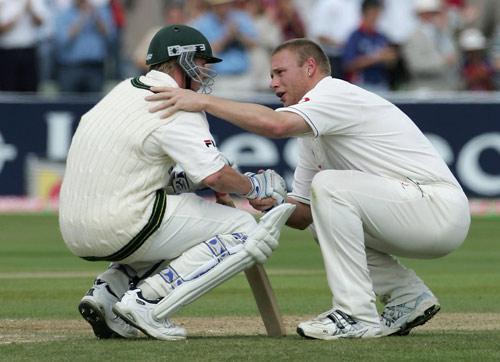
We didn’t annihilate Australia. We raced them in a marathon and after 26 miles we won it on a photo-finish. That’s what prompted the unprecedented joy, the ticker-tape parades, the MBEs.
Australians don’t see it that way. They live to win, and above all, to win over England. The Poms, the stuck-up older brothers, the stuffy parents. They lost the Ashes and even a photo-finish loss will hurt them far more than a thrashing can ever hurt us.
So they wanted to murder this team. To annihilate them, humiliate them, to mercilessly crush them, to bury them and dance on the grave: to do the unthinkable, the obscene, the pornographic horrorshow – the whitewash. And because this Australia team comprises the best set of cricket players ever, and is the most bloodthirsty team ever, they did it.
All of which brings me back to a piece written by my favourite sports writer, Simon Barnes, back in May:
SOME will tell you that sport is all about winning. Have nothing to do with such people. Winning is not the only thing in sport. There is also, for example, losing. Losing is one of the most important things in sport, and people do it all the time, and in a thousand different ways. You can lose gloriously, dramatically, heroically, unluckily, abjectly, humiliatingly, defiantly, haplessly.
You can lose by a street, by a distance, a canvas, a short head, a knockout, on points. You can be hammered, trounced, beaten out of sight. You can be edged out, beaten by the narrowest of margins. You can be beaten and hang up your boots/gloves/bat/racket; you can be beaten and take a lot of positives from this.
But it all adds up to the same common experience of sport: not winning.
Take Wimbledon. The men’s and women’s singles each begin with 128 competitors. After the first round, half of them are already losers. That’s 64 athletes wiped out at a stroke: beaten, stuffed, trounced, second-best. By the time they have played the final, the number of losers has risen to 127. How can winning possibly be the only thing when so many people in sport quite patently are not doing it? Steve Archibald famously said that team spirit is an illusion glimpsed in victory. The idea that winning is the only thing is the same kind of illusion.
But we repress the idea of losing. So much of the sporting experience is about anticipation: the sort of things we might do, when it all begins. And in anticipation, we are all champions, and the teams we follow and cheer for and cherish are always unbeatable. Until, of course, we are beaten.
Defeat is the sporting experience that dare not speak its name. Defeat is the thing that keeps us coming back: for when victory is certain, where is the joy? A mismatch brings no pleasure to the winner, and we call such victories hollow. The United States Dream Team basketball sides of the Barcelona and Atlanta Olympic Games were no fun, not even to Americans, just a tautological demonstration of American global supremacy.
Victory is not much of a dish unless it is seasoned with the possibility of defeat. And even when teams or individuals dominate for a sustained period of time, we know that defeat will get them in the end. It always does: Steve Davis, Pete Sampras, Wigan, West Indies, Liverpool, Manchester United, Australia. Defeat is thrilling, defeat is intoxicating, defeat is the most exciting thing in sport, apart, that is, from winning.
.... Last summer, England won the Ashes, and the joy of the victory sprang from almost 20 years of unbroken defeat by Australia, and intermittent defeat by practically everybody else. Without that history of defeat, victory would have been far less sweet. Defeat is a constituent part of sporting joy.
We are as hooked on defeat as we are on victory. Sport would not be sport without misery, without despair, without hopelessness. Victory is for wimps: it is in defeat that the true spirit of sport is to be found.
Welcome home, boys. Welcome home.
Tuesday, January 02, 2007
A Song for Christmas
Ghosts of Christmas
Christmas, like revenge and copulation,
Is mostly fun in the anticipation.
It’s weeks, it’s days, and now it’s here, it’s here!
And now it’s gone, in a haze of port and beer,
And leaves you wondering where the hell it went.
Children learn this lesson in Advent,
Or should do, or else what is Advent for?
To prise open each tiny cardboard door
And find this surprise: the trick is not to cheat
But to let tomorrow’s star or chocolate treat,
Come in its time, and surely Time will claw
Its agonising way to Twenty Four.
Or Mum will say “You really are the worst,
You’ve only scoffed the whole lot on the First!”
And Dad will say “Son, to delay such feasts
Is what separates us humans from the beasts.”
But come Christmas Day, Dad’s bestial enough
Postprandial, and just like his turkey, stuffed.
Immobile as a slumbering manger ox
and mumbling that there’s nothing on the box,
(Except repeats of good old Tommy Cooper,
Just peeping through the brandy butter stupor,
And Morecambe and Wise – that one with André Previn)
Until half-awake at twenty-five to seven,
His head humming with Jingle Bells and Slade,
He’ll dimly total up the price he’s paid
In cash and flab and stress and indigestion,
Then dimmer still, the philosophic question:
How come every year it seems to me
That Christmas isn’t what it used to be?
And if it’s every year, should I infer
That Christmases were never what they were?
And then he’ll root around the plastic tree,
Scavenging for scraps of childish glee,
And finding none, he’ll conjure up at last,
That great parade of Ghosts of Christmas Past,
The Great-Grandmas and Grandmas and Grandads,
Their grins and gins, and ‘when-I-were-a-lad’s,
And carol-singing schoolmates in their dozens,
And lonely aunts, and plain annoying cousins,
Who, all on separate currents, drift apart,
With all that love and loss, to break your heart,
It all came in its time, and Time claws past
Each long-awaited Christmas 'til your last.
But did those ghosts believe it, every one,
That this is really it now, this is fun?
Or were they all just waiting, and then it went.
We should have learnt that lesson in Advent.
So we’ll shovel snow from the graves of our relations,
But there are no graves – these days it’s all cremations,
And there is no snow – English Christmases aren’t white,
So instead let’s drink, and a bid a Silent Night
To the days when only laughs and presents mattered,
And to family and friends and ashes: scattered.
Christmas, like revenge and copulation,
Is mostly fun in the anticipation.
It’s weeks, it’s days, and now it’s here, it’s here!
And now it’s gone, in a haze of port and beer,
And leaves you wondering where the hell it went.
Children learn this lesson in Advent,
Or should do, or else what is Advent for?
To prise open each tiny cardboard door
And find this surprise: the trick is not to cheat
But to let tomorrow’s star or chocolate treat,
Come in its time, and surely Time will claw
Its agonising way to Twenty Four.
Or Mum will say “You really are the worst,
You’ve only scoffed the whole lot on the First!”
And Dad will say “Son, to delay such feasts
Is what separates us humans from the beasts.”
But come Christmas Day, Dad’s bestial enough
Postprandial, and just like his turkey, stuffed.
Immobile as a slumbering manger ox
and mumbling that there’s nothing on the box,
(Except repeats of good old Tommy Cooper,
Just peeping through the brandy butter stupor,
And Morecambe and Wise – that one with André Previn)
Until half-awake at twenty-five to seven,
His head humming with Jingle Bells and Slade,
He’ll dimly total up the price he’s paid
In cash and flab and stress and indigestion,
Then dimmer still, the philosophic question:
How come every year it seems to me
That Christmas isn’t what it used to be?
And if it’s every year, should I infer
That Christmases were never what they were?
And then he’ll root around the plastic tree,
Scavenging for scraps of childish glee,
And finding none, he’ll conjure up at last,
That great parade of Ghosts of Christmas Past,
The Great-Grandmas and Grandmas and Grandads,
Their grins and gins, and ‘when-I-were-a-lad’s,
And carol-singing schoolmates in their dozens,
And lonely aunts, and plain annoying cousins,
Who, all on separate currents, drift apart,
With all that love and loss, to break your heart,
It all came in its time, and Time claws past
Each long-awaited Christmas 'til your last.
But did those ghosts believe it, every one,
That this is really it now, this is fun?
Or were they all just waiting, and then it went.
We should have learnt that lesson in Advent.
So we’ll shovel snow from the graves of our relations,
But there are no graves – these days it’s all cremations,
And there is no snow – English Christmases aren’t white,
So instead let’s drink, and a bid a Silent Night
To the days when only laughs and presents mattered,
And to family and friends and ashes: scattered.
Casino Royale
Wowee - how good was that? Apart from the theme tune, which was average, surely the best Bond film ever in every way?
Sunday, December 31, 2006
The best thing about the holidays...
...is napping. Forty winks. Catching a few zeds. Or as the Brit pater familias always put it, with that strange human reluctance to admit that we're actually going to sleep during daylight hours: "Going upstairs to contemplate the Mysteries of the Infinite."
I am now firmly of the opinion that remaining fully awake through an entire afternoon is against human nature, all religions and the inherent mechanical laws of the Universe.
I am now firmly of the opinion that remaining fully awake through an entire afternoon is against human nature, all religions and the inherent mechanical laws of the Universe.
Diversification
A new blog to add to your favourites list: long-time friend and sparring partner Peter Burnet has at long last hoisted his own flag, at Diversely We Sail.
Saturday, December 30, 2006
Kidney update
If you're ever in the vicinity of Clyst Hydon, Devon, I can heartily recommend the steak-and-kidney pudding at the Five Bells Inn.
Chock-full of the stuff. Wash it down with a pint of Royal Oak.
Chock-full of the stuff. Wash it down with a pint of Royal Oak.
Friday, December 22, 2006
The goose is getting fat
Aaaaaaah The Two Ronnies! As English as yellowing Penguin Classics and cannons at dawn. Since it’s Christmas, here’s one that’s as familiar and comfortable as a pair of old slippers….
A Merry Yuletide to all of you: with thanks to all those who’ve helped make TofE such an exciting place this year, and curses to those who’ve hindered.
A Merry Yuletide to all of you: with thanks to all those who’ve helped make TofE such an exciting place this year, and curses to those who’ve hindered.
Tuesday, December 19, 2006
Everyone has the right to be equally miserable
Jamie Whyte writes a beautifully clear and concise piece in The Times, called How human rights always lead to human wrongs
….Initially, our self-evident human rights were simply protections against the abuse of power. Today, entitlements to all manner of goods are making themselves evident to human rights oracles. Louise Arbour, the UN High Commissioner for Human Rights, claims that we have human rights “to food, to work, to healthcare and housing”.
This inflation has changed the politics of human rights. Whereas human rights once supported limited government, they are now invoked in favour of the welfare state and the maximal government it requires. Which is why the human rights movement, although well intentioned, has become a malign force.
In an article to mark Human Rights Day this month, Ms Arbour claimed that poverty is caused by human rights violations. It is true, of course, that if people had food, healthcare and housing, they would not live in poverty. But it is absurd to say that lacking these things causes poverty. Lacking these things is poverty. Why do millions of people lack decent food, healthcare and housing? That is the question.
The human rights lobby sees poverty as an essentially legal problem. All humans are entitled to food, healthcare, housing and so on. But countries where poverty is common have failed to enshrine these entitlements in law. If they embraced human rights, poverty would be legislated out of existence.
If you are tempted to agree, perhaps you will also like this idea. The government should enrich us by passing a law that entitles all Brits to an annual income of at least one million pounds. The difficulty, of course, is that Britain’s GDP is considerably less than one million pounds per person. It is impossible to provide everyone with this income.
The same goes for the more modest entitlements that human rights enthusiasts claim to be universal. Providing every citizen with decent food, healthcare and housing exceeds the productive capacity of many poor countries. Mauritania’s annual GDP, for example, is only $400 per person. It would be nice if Mauritanians were richer, but declaring that they should be will not help. Entitlements to wealth do not create wealth. On the contrary, they hinder wealth creation.
…..
The causes of poverty are debated by economists. Yet most agree that property rights are essential for wealth creation. Without them, wealth cannot be accrued. And if people cannot accrue wealth, they have little incentive to create it. Why invest capital and effort in a business if you cannot feel secure in your ownership of it, and of the profits that flow from it? Communism and anarchy create poverty in the same way: by undermining property rights.
Property rights are not universal entitlements. If I own some land then you do not own it. You lack entitlements that I enjoy, such as the profits made by farming that land. Such inequalities are inherent to property rights. Which may explain why human rights activists do not care for them. In an 800-word article on fighting poverty, Ms Arbour did not once mention property rights. Instead, she lamented “unequal access to resources” — something entailed by private ownership of them.
Tens of millions of Chinese have worked their way out of poverty in recent years. It was not achieved by extending human rights law in China. Nor is it an “economic miracle”. It is a predictable consequence of establishing property rights.
It is a strange aspect of the Leftist outlook – which has a monopoly on many international institutions and public bodies, but not on any successful Government in history – to ignore the lessons of reality.
Rather than examining why the West has succeeded in creating unprecedented wealth and standards of living, while Communism has succeeded only in creating unprecedented misery and atrocity, it is considered more important to talk about ideology, as if ideology mattered.
There comes a point, however, where well-meaning but misguided becomes stubborn, arrogant and eventually, evil.
….Initially, our self-evident human rights were simply protections against the abuse of power. Today, entitlements to all manner of goods are making themselves evident to human rights oracles. Louise Arbour, the UN High Commissioner for Human Rights, claims that we have human rights “to food, to work, to healthcare and housing”.
This inflation has changed the politics of human rights. Whereas human rights once supported limited government, they are now invoked in favour of the welfare state and the maximal government it requires. Which is why the human rights movement, although well intentioned, has become a malign force.
In an article to mark Human Rights Day this month, Ms Arbour claimed that poverty is caused by human rights violations. It is true, of course, that if people had food, healthcare and housing, they would not live in poverty. But it is absurd to say that lacking these things causes poverty. Lacking these things is poverty. Why do millions of people lack decent food, healthcare and housing? That is the question.
The human rights lobby sees poverty as an essentially legal problem. All humans are entitled to food, healthcare, housing and so on. But countries where poverty is common have failed to enshrine these entitlements in law. If they embraced human rights, poverty would be legislated out of existence.
If you are tempted to agree, perhaps you will also like this idea. The government should enrich us by passing a law that entitles all Brits to an annual income of at least one million pounds. The difficulty, of course, is that Britain’s GDP is considerably less than one million pounds per person. It is impossible to provide everyone with this income.
The same goes for the more modest entitlements that human rights enthusiasts claim to be universal. Providing every citizen with decent food, healthcare and housing exceeds the productive capacity of many poor countries. Mauritania’s annual GDP, for example, is only $400 per person. It would be nice if Mauritanians were richer, but declaring that they should be will not help. Entitlements to wealth do not create wealth. On the contrary, they hinder wealth creation.
…..
The causes of poverty are debated by economists. Yet most agree that property rights are essential for wealth creation. Without them, wealth cannot be accrued. And if people cannot accrue wealth, they have little incentive to create it. Why invest capital and effort in a business if you cannot feel secure in your ownership of it, and of the profits that flow from it? Communism and anarchy create poverty in the same way: by undermining property rights.
Property rights are not universal entitlements. If I own some land then you do not own it. You lack entitlements that I enjoy, such as the profits made by farming that land. Such inequalities are inherent to property rights. Which may explain why human rights activists do not care for them. In an 800-word article on fighting poverty, Ms Arbour did not once mention property rights. Instead, she lamented “unequal access to resources” — something entailed by private ownership of them.
Tens of millions of Chinese have worked their way out of poverty in recent years. It was not achieved by extending human rights law in China. Nor is it an “economic miracle”. It is a predictable consequence of establishing property rights.
It is a strange aspect of the Leftist outlook – which has a monopoly on many international institutions and public bodies, but not on any successful Government in history – to ignore the lessons of reality.
Rather than examining why the West has succeeded in creating unprecedented wealth and standards of living, while Communism has succeeded only in creating unprecedented misery and atrocity, it is considered more important to talk about ideology, as if ideology mattered.
There comes a point, however, where well-meaning but misguided becomes stubborn, arrogant and eventually, evil.
Friday, December 15, 2006
Desert Island Discs
Aaaaaaaaah, Desert Island Discs! As English as gin in teacups and leaves on the lawn - the Sunday morning sound of plummy voices and scratchy records, sandwiched between The Archers omnibus and I’m Sorry I Haven’t a Clue, with the rich kitchen aroma of lamb roasting and the imminent promise of slipping down the local for a pre-lunch bitter, back for grub, then a solid afternoon’s dozing in front of the football. Unbeatable.
Desert Island Discs, born in 1942, is the longest running music programme in the history of radio, proving that the deep, geeky pleasure of compiling personal Top 10 type lists, of categorizing your cultural make-up, was merely taken to its logical conclusion (and then way, way beyond) by Nick Hornby, not invented by him.
D.I.D is the mother of all List shows. Virtually every famous or worthy Briton has appeared at some point, including Noel Coward, Rowan Williams and all the last five Prime Ministers. The format is simple enough – you get to choose your eight favourite records to take on a desert island and between justifying your selections you talk about the triumphs and disasters of your long and fascinating life.
Over the years I have identified three different approaches taken by the guests to the problem of choosing just eight tunes from the billions available.
The first approach is just to pick your eight bestest songs. Thus Tory MP Ken Clarke had eight swing jazz records. The second is to pick the eight tracks that are least likely to drive you mad after endless repetitive playing in the isolation of a desert island. Though sensible if you were actually about to be packed off to a life of interminable solitude and boredom, this method seems to me to be taking the thing rather too seriously.
The third – and I suppose the most suitable method for the programme – is to take an autobiographical approach, selecting tunes that represent important stages or moments in your life.
The fourth method – which I will call the Politician’s Method – is to pick (or get your PR team to pick) music that you think will make you appear cool.
My two penn’oth (as at 15 December 2006)
In truth, most castaways take a line mixing all four approaches, and so will I. But since it is much more fun to agonisingly whittle down your own list than to read those of others, I will whistle through my selection tolerably quickly. (It is agony by the way, because after a while you start getting really quite upset about leaving things out. I’ve had to jettison the Beatles, Beethoven, Bob Dylan – and that’s just the B’s).
(By the way, you also get to choose a luxury and one book (in addition to the complete Shakespeare and the Bible). Those are easy enough. A life without Test Match Special is not worth the living, so Radio 4 Longwave is the obvious luxury, and the book will of course be the Aubrey-Maturin series in one huge volume.) So on to the records:
First up is Buddy Holly’s Rave On, which the Brit Pater Familias had on an LP and which was the first piece of music to make me spontaneously jump on the spot. As soon I was old enough to work the record player, I would play it repeatedly, leaping about the furniture like the miniature rock 'n roll monkey I was. That introductory “We-a- -he-he-he hell” is still the best thing in rock music.
The next four selections can be hurdled at a relative gallop, being all classical and all heartbreakingly maudlin. I Know that My Redeemer Liveth from Handel’s Messiah is a burst of Catholic beauty; then Mozart’s Clarinet Concerto; followed by Chopin’s Nocturne No 7 in C sharp minor; and Boccherini’s La Musica Notturna delle strade di Madrid (which is a cello/violin piece used recently in the Master and Commander film and thus the perfect accompaniment to my reading).
Number Six is Cemetry Gates by the Smiths. I have to have some pop music, since so much of my time and money has been frittered away on it, and this song’s Englishness would help keep me sane. Number Seven is Gerry and the Pacemakers’ version of You’ll Never Walk Alone, for obvious sentimental and tribal reasons.
You are also required to rescue one of your eight records in an imaginary tidal wave. This is straightforward enough, since record number eight is O Mio Babbino Caro, from Puccini’s Gianni Schicchi.
This two minutes of sublime light shone on our world of petty woes is here channeled through Angela Gheorghiu. Get your tear-pricking and spine-tingling apparatus ready:
(YouTube also has renditions by Kiri te Kanawa and even Maria Callas. O brave new world!)
Since none of us will ever get on the actual programme, please feel free to use the comments section as an outlet for your own Desert Island Disc compiling urges.
Desert Island Discs, born in 1942, is the longest running music programme in the history of radio, proving that the deep, geeky pleasure of compiling personal Top 10 type lists, of categorizing your cultural make-up, was merely taken to its logical conclusion (and then way, way beyond) by Nick Hornby, not invented by him.
D.I.D is the mother of all List shows. Virtually every famous or worthy Briton has appeared at some point, including Noel Coward, Rowan Williams and all the last five Prime Ministers. The format is simple enough – you get to choose your eight favourite records to take on a desert island and between justifying your selections you talk about the triumphs and disasters of your long and fascinating life.
Over the years I have identified three different approaches taken by the guests to the problem of choosing just eight tunes from the billions available.
The first approach is just to pick your eight bestest songs. Thus Tory MP Ken Clarke had eight swing jazz records. The second is to pick the eight tracks that are least likely to drive you mad after endless repetitive playing in the isolation of a desert island. Though sensible if you were actually about to be packed off to a life of interminable solitude and boredom, this method seems to me to be taking the thing rather too seriously.
The third – and I suppose the most suitable method for the programme – is to take an autobiographical approach, selecting tunes that represent important stages or moments in your life.
The fourth method – which I will call the Politician’s Method – is to pick (or get your PR team to pick) music that you think will make you appear cool.
My two penn’oth (as at 15 December 2006)
In truth, most castaways take a line mixing all four approaches, and so will I. But since it is much more fun to agonisingly whittle down your own list than to read those of others, I will whistle through my selection tolerably quickly. (It is agony by the way, because after a while you start getting really quite upset about leaving things out. I’ve had to jettison the Beatles, Beethoven, Bob Dylan – and that’s just the B’s).
(By the way, you also get to choose a luxury and one book (in addition to the complete Shakespeare and the Bible). Those are easy enough. A life without Test Match Special is not worth the living, so Radio 4 Longwave is the obvious luxury, and the book will of course be the Aubrey-Maturin series in one huge volume.) So on to the records:
First up is Buddy Holly’s Rave On, which the Brit Pater Familias had on an LP and which was the first piece of music to make me spontaneously jump on the spot. As soon I was old enough to work the record player, I would play it repeatedly, leaping about the furniture like the miniature rock 'n roll monkey I was. That introductory “We-a- -he-he-he hell” is still the best thing in rock music.
The next four selections can be hurdled at a relative gallop, being all classical and all heartbreakingly maudlin. I Know that My Redeemer Liveth from Handel’s Messiah is a burst of Catholic beauty; then Mozart’s Clarinet Concerto; followed by Chopin’s Nocturne No 7 in C sharp minor; and Boccherini’s La Musica Notturna delle strade di Madrid (which is a cello/violin piece used recently in the Master and Commander film and thus the perfect accompaniment to my reading).
Number Six is Cemetry Gates by the Smiths. I have to have some pop music, since so much of my time and money has been frittered away on it, and this song’s Englishness would help keep me sane. Number Seven is Gerry and the Pacemakers’ version of You’ll Never Walk Alone, for obvious sentimental and tribal reasons.
You are also required to rescue one of your eight records in an imaginary tidal wave. This is straightforward enough, since record number eight is O Mio Babbino Caro, from Puccini’s Gianni Schicchi.
This two minutes of sublime light shone on our world of petty woes is here channeled through Angela Gheorghiu. Get your tear-pricking and spine-tingling apparatus ready:
(YouTube also has renditions by Kiri te Kanawa and even Maria Callas. O brave new world!)
Since none of us will ever get on the actual programme, please feel free to use the comments section as an outlet for your own Desert Island Disc compiling urges.
Wednesday, December 13, 2006
And still talking of it
The ultimate act of self-sacrifice that no one noticed
Emine Saner
Thursday November 30, 2006
The Grauniad
To motorists on Chicago's Kennedy expressway on the morning of November 3, the fire was just an annoyance, slowing their journey into work. It appeared as if someone had set the city's sculpture of a giant flame, which stands by the road, on fire. Most of those commuters didn't hear for some time that it wasn't the sculpture on fire, but a 52-year-old anti-war protester, Malachi Ritscher. Many probably never heard about it.
Ritscher's death, four days before the American mid-term elections, wasn't the shocking, national news story he had hoped it would be when he doused himself in petrol and set himself alight, next to a video camera and a small sign reading, "Thou shalt not kill." It hardly made a ripple in Chicago's mainstream media until an alternative newspaper picked it up. Nationally and internationally, his death has gone virtually unnoticed.
Although he had held protests against the Iraq war for several years, Ritscher's final act has largely been dismissed as that of someone suffering from mental illness - he had a history of depression and alcoholism and surely nobody of sound mind would choose this, one of the most agonising ways to die. But although his mission statement, posted on his website before he died, showed he was somewhat eccentric (he wrote that he regretted missing an opportunity to assassinate Donald Rumsfeld), it is by no means an incoherent ramble. "If I am required to pay for your barbaric war, I choose not to live in your world," he wrote. "I refuse to finance the mass murder of innocent civilians, who did nothing to threaten our country."
Emine Saner
Thursday November 30, 2006
The Grauniad
To motorists on Chicago's Kennedy expressway on the morning of November 3, the fire was just an annoyance, slowing their journey into work. It appeared as if someone had set the city's sculpture of a giant flame, which stands by the road, on fire. Most of those commuters didn't hear for some time that it wasn't the sculpture on fire, but a 52-year-old anti-war protester, Malachi Ritscher. Many probably never heard about it.
Ritscher's death, four days before the American mid-term elections, wasn't the shocking, national news story he had hoped it would be when he doused himself in petrol and set himself alight, next to a video camera and a small sign reading, "Thou shalt not kill." It hardly made a ripple in Chicago's mainstream media until an alternative newspaper picked it up. Nationally and internationally, his death has gone virtually unnoticed.
Although he had held protests against the Iraq war for several years, Ritscher's final act has largely been dismissed as that of someone suffering from mental illness - he had a history of depression and alcoholism and surely nobody of sound mind would choose this, one of the most agonising ways to die. But although his mission statement, posted on his website before he died, showed he was somewhat eccentric (he wrote that he regretted missing an opportunity to assassinate Donald Rumsfeld), it is by no means an incoherent ramble. "If I am required to pay for your barbaric war, I choose not to live in your world," he wrote. "I refuse to finance the mass murder of innocent civilians, who did nothing to threaten our country."
My emphasis in both cases.
Talking of which
This strange man is standing outside Parliament bedecked in a protest sign that reads "Denied the right to protest".
Monday, December 11, 2006
Too much government
On ePolitix today:
The prime minister has unveiled 500 new measures to cut Whitehall red tape.
Nineteen government departments will publish plans to save businesses and charities more than £2bn a year.
Is it just me, or is that opening sentence somewhat self-contradictory?
The prime minister has unveiled 500 new measures to cut Whitehall red tape.
Nineteen government departments will publish plans to save businesses and charities more than £2bn a year.
Is it just me, or is that opening sentence somewhat self-contradictory?
Saturday, December 09, 2006
Apropos of nothing
This morning, as I walked back from the papershop with my Times tucked under my arm, a sunny winter morning, hilly pavement, terraced townhouses, the brandy cobwebs clearing, I passed an unremarkable couple standing and chatting on a corner. He too had a newspaper; she was a thin, mature lady holding a lead, at the end of which was a Chihuahua shivering in a little tartan doggy coat.
I walked on and thirty yards down the road I passed another unremarkable couple standing and chatting on a corner. He had a newspaper; she was an even thinner, even more mature lady, holding a lead, at the end of which was a Chihuahua shivering in a little blue coat and what appeared to be a little blue doggy scarf.
O what a piece of work is man.
I walked on and thirty yards down the road I passed another unremarkable couple standing and chatting on a corner. He had a newspaper; she was an even thinner, even more mature lady, holding a lead, at the end of which was a Chihuahua shivering in a little blue coat and what appeared to be a little blue doggy scarf.
O what a piece of work is man.
Tuesday, December 05, 2006
Cancel Christmas
Never before in the history of Test cricket has a team declared in the first innings with so many runs on the board and gone on to lose.
Maudlin doesn't begin to cover it, but as England contrive to record literally the most extreme example of snatching defeat from the jaws of victory in the history of the sport, we can finally see that last summer was indeed a glorious freak, and once more sink back into the familiar arms of the kind of epic failure that has been our faithful companion for most of our cricketing lifetimes.
Maudlin doesn't begin to cover it, but as England contrive to record literally the most extreme example of snatching defeat from the jaws of victory in the history of the sport, we can finally see that last summer was indeed a glorious freak, and once more sink back into the familiar arms of the kind of epic failure that has been our faithful companion for most of our cricketing lifetimes.
Monday, December 04, 2006
Measuring Maudlin
Being an American, and thus predisposed towards the crudely literal, Duck took exception to my description of his musical tastes as ‘maudlin’ because he looked up the word in a dictionary.
Dictionaries be damned: properly understood, maudlinity is nothing to be ashamed of. Celebrate your maudlinness! Much great art is magnificently maudlin. Maudlinosity lies somewhere in the middle of a sliding scale of sweet sadness, which begins at Melancholy and reaches its darkest depths in Morose. But beware: without care, it is all too easy to fall off the poignant path, the lachrymose lane, and land in the ditch of naffness that is Moribund.
The following examples should clarify matters so that there can be no further confusion about the subject, beginning with a seasonal theme:
Melancholy: In the Bleak Midwinter
Maudlin: Silent Night
Morose: A dead reindeer in the snow
Moribund: Jingle All the Way, starring Arnold Schwarzenegger
Melancholy: Solitary night-hawks at the bar, after hours
Maudlin: A solitary walk in the rain, after the funeral
Morose: Bowling alone
Moribund: Simulating bowling alone on your Nintendo Wii
Melancholy: the life and death of Lenny Bruce
Maudlin: Somewhere from West Side Story, by Leonard Bernstein
Morose: Leanord Cohen singing Hallelujah
Moribund: The German stage production of Leonard Cohen’s Hallelujah
Melancholy: French existentialism
Maudlin: English sonnets
Morose: Russian angst in ballet form
Moribund: Esperanto
Dictionaries be damned: properly understood, maudlinity is nothing to be ashamed of. Celebrate your maudlinness! Much great art is magnificently maudlin. Maudlinosity lies somewhere in the middle of a sliding scale of sweet sadness, which begins at Melancholy and reaches its darkest depths in Morose. But beware: without care, it is all too easy to fall off the poignant path, the lachrymose lane, and land in the ditch of naffness that is Moribund.
The following examples should clarify matters so that there can be no further confusion about the subject, beginning with a seasonal theme:
Melancholy: In the Bleak Midwinter
Maudlin: Silent Night
Morose: A dead reindeer in the snow
Moribund: Jingle All the Way, starring Arnold Schwarzenegger
Melancholy: Solitary night-hawks at the bar, after hours
Maudlin: A solitary walk in the rain, after the funeral
Morose: Bowling alone
Moribund: Simulating bowling alone on your Nintendo Wii
Melancholy: the life and death of Lenny Bruce
Maudlin: Somewhere from West Side Story, by Leonard Bernstein
Morose: Leanord Cohen singing Hallelujah
Moribund: The German stage production of Leonard Cohen’s Hallelujah
Melancholy: French existentialism
Maudlin: English sonnets
Morose: Russian angst in ballet form
Moribund: Esperanto
Subscribe to:
Posts (Atom)